


Page 16 - Time Special Edition Alternative Medicine (January 2020)
P. 16
ALTERNATIVE MEDICINE THE NEW MAINSTREAM
puncture’s potential as a non-pharmaceutical op-
tion for treating for the painful syndrome. “People
don’t want to take a medication that causes its own
side effects to treat the side effects of another medi- After Surgery:
cation,” says Hershman. “And in this country right
now, we want to do everything we can to avoid pre- Supporting the
scribing opioids, especially on a long-term basis.”
Hershman and her colleagues enrolled 226 pa-
tients with early-stage breast cancer from 11 treat- Recovery Process
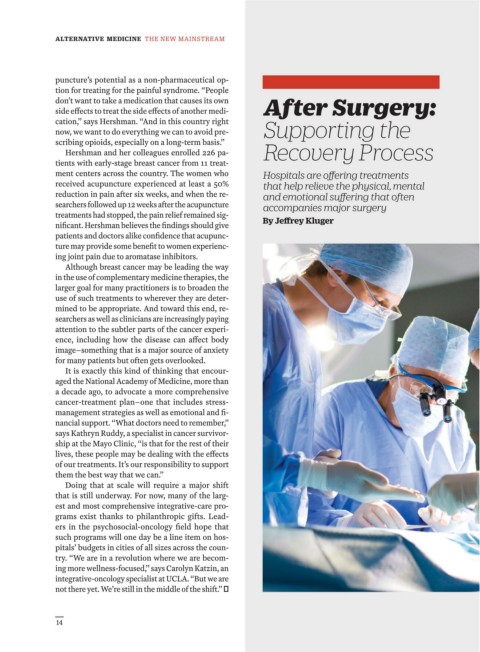
ment centers across the country. The women who Hospitals are offering treatments
received acupuncture experienced at least a 50% that help relieve the physical, mental
reduction in pain after six weeks, and when the re- and emotional suffering that often
searchers followed up 12 weeks after the acupuncture accompanies major surgery
treatments had stopped, the pain relief remained sig-
By Jeffrey Kluger
nificant. Hershman believes the findings should give
patients and doctors alike confidence that acupunc-
ture may provide some benefit to women experienc-
ing joint pain due to aromatase inhibitors.
Although breast cancer may be leading the way
in the use of complementary medicine therapies, the
larger goal for many practitioners is to broaden the
use of such treatments to wherever they are deter-
mined to be appropriate. And toward this end, re-
searchers as well as clinicians are increasingly paying
attention to the subtler parts of the cancer experi-
ence, including how the disease can affect body
image–something that is a major source of anxiety
for many patients but often gets overlooked.
It is exactly this kind of thinking that encour-
aged the National Academy of Medicine, more than
a decade ago, to advocate a more comprehensive
cancer-treatment plan–one that includes stress-
management strategies as well as emotional and fi-
nancial support. “What doctors need to remember,”
says Kathryn Ruddy, a specialist in cancer survivor-
ship at the Mayo Clinic, “is that for the rest of their
lives, these people may be dealing with the effects
of our treatments. It’s our responsibility to support
them the best way that we can.”
Doing that at scale will require a major shift
that is still underway. For now, many of the larg-
est and most comprehensive integrative-care pro-
grams exist thanks to philanthropic gifts. Lead-
ers in the psychosocial-oncology field hope that
such programs will one day be a line item on hos-
pitals’ budgets in cities of all sizes across the coun-
try. “We are in a revolution where we are becom-
ing more wellness-focused,” says Carolyn Katzin, an
integrative-oncology specialist at UCLA. “But we are
not there yet. We’re still in the middle of the shift.”
14

