


Page 22 - Time Special Edition Alternative Medicine (January 2020)
P. 22
ALTERNATIVE      MEDICINE THE NEW MAINSTREAM


                   How it works

                   funcTional       magneTic      resonance      imaging
                   (fMRI) has revealed that when volunteers are sub-
                   jected  to  mild  electrical  shock  while  under going
                   acupuncture, there is much less activity in four dif-
                   ferent  pain-processing    regions   of  the  brain  than
                   usual. Although the pain stimulus continues, the
                   brain notices it less. A fifth re gion—the anterior in-

                   sula, which governs the ex pectation of pain—quiets
                   down too. Often, the less pain you expect to feel, the
                   less you do feel, a tail-wagging-the-dog phenome-
                   non that is key to the placebo effect. If sham acu-
                   puncture produces only partial results, it may be
                   because it affects only the insula rather than all the
                   areas that deal with pain sensation. In any case, how-

                   ever, it is clear that something hap pens. “Acupunc-
                   ture is supposed to act through at least two mech-
                   anisms: nonspecific expectancy -based effects and
                   specific modulation of the incoming pain signal,”
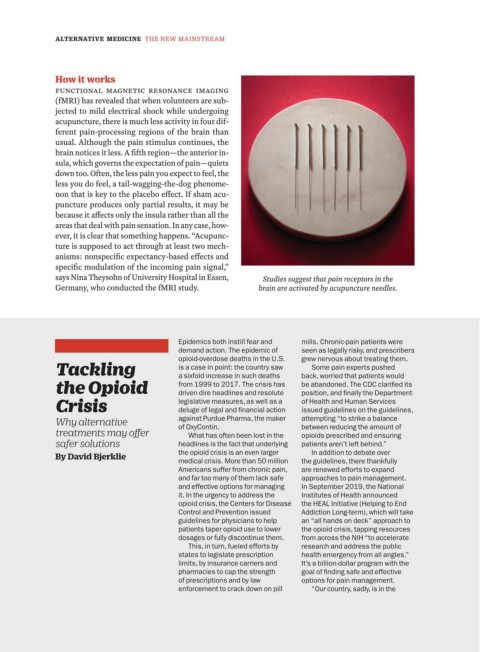
                   says Nina Theysohn of University Hospital in Essen,                 Studies suggest that pain receptors in the
                   Germany, who conducted the fMRI study.                             brain are activated by acupuncture needles.


                                                           Epidemics both instill fear and          mills. Chronic-pain patients were
                                                           demand action. The epidemic of           seen as legally risky, and prescribers
                                                           opioid-overdose deaths in the U.S.       grew nervous about treating them.
                   Tackling                                is a case in point: the country saw      back, worried that patients would
                                                                                                       Some pain experts pushed
                                                           a sixfold increase in such deaths
                   the Opioid                              from 1999 to 2017. The crisis has        be abandoned. The CDC clarified its
                                                           driven dire headlines and resolute
                                                                                                    position, and finally the Department
                   Crisis                                  legislative measures, as well as a       of Health and Human Services
                                                           deluge of legal and financial action
                                                                                                    issued guidelines on the guidelines,
                   Why alternative                         against Purdue Pharma, the maker         attempting “to strike a balance
                                                                                                    between reducing the amount of
                                                           of OxyContin.
                   treatments may offer                        What has often been lost in the      opioids prescribed and ensuring
                   safer solutions                         headlines is the fact that underlying    patients aren’t left behind.”
                                                           the opioid crisis is an even larger         In addition to debate over
                   By David Bjerklie
                                                           medical crisis. More than 50 million     the guidelines, there thankfully
                                                           Americans suffer from chronic pain,      are renewed efforts to expand
                                                           and far too many of them lack safe       approaches to pain management.
                                                           and effective options for managing       In September 2019, the National
                                                           it. In the urgency to address the        Institutes of Health announced
                                                           opioid crisis, the Centers for Disease     the HEAL Initiative (Helping to End
                                                           Control and Prevention issued            Addiction Long-term), which will take
                                                           guidelines for physicians to help        an “all hands on deck” approach to
                                                           patients taper opioid use to lower       the opioid crisis, tapping resources
                                                           dosages or fully discontinue them.       from across the NIH “to accelerate
                                                               This, in turn, fueled efforts by     research and address the public
                                                           states to legislate prescription         health emergency from all angles.”
                                                           limits, by insurance carriers and        It’s a billion-dollar program with the
                                                           pharmacies to cap the strength           goal of finding safe and effective
                                                           of prescriptions and by law              options for pain management.
                                                           enforcement to crack down on pill           “Our country, sadly, is in the

