


Page 20 - Time Special Edition Alternative Medicine (January 2020)
P. 20
ALTERNATIVE      MEDICINE THE NEW MAINSTREAM


                      Civilian   practitioners    have   embraced      acu-
                   puncture in an even bigger way. Leading Ameri can
                   hospitals like the Mayo Clinic and the Cleve land
                   Clinic offer it as part of their alternative-care pack-
                   ages. And numerous groups, including the Ameri-
                   can Medical Association, have succeeded in getting
                   a few states, including California, to designate acu-
                   puncture an “essential health benefit” under the Af-

                   fordable Care Act. The move requires health insur-
                   ers to include it on their list of covered services.
                      But just because a treatment is popular—even
                   one that has been around for millennia —that doesn’t
                   guarantee that it is effective. If it were, we’d long
                   since have cleansed, Rolfed and low- carbed our way
                   to immortality. More and more, though, acupunc-

                   ture is getting the close em pirical scrutiny that mod-
                   ern drugs and medical procedures are routinely sub-
                   jected to. And the results are, well, mixed.
                      A growing body of experimental evidence shows
                   that acupuncture does indeed work, in some cases
                   extraordinarily well. Another body suggests that it
                   may very well work, but not for the reasons believers
                   think. And yet a third body of “beats me” findings
                   is sufficient to keep par tisans on both sides arguing.

                   In any case, some thing is clearly going on—and that
                   something may, at least in some cases, be a cure for
                   what ails you.


                   Crunching the numbers
                   afTer colds and flu, pain is The mosT com-

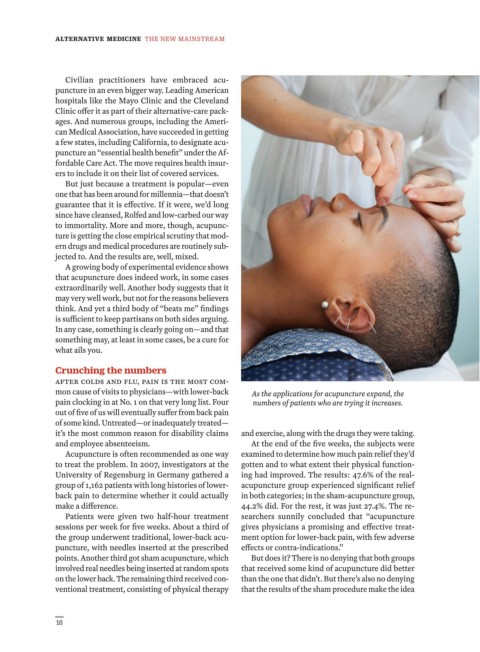
                   mon cause of visits to physicians—with lower -back              As the applications for acupuncture expand, the
                   pain clocking in at No. 1 on that very long list. Four           numbers of patients who are trying it increases.
                   out of five of us will eventually suffer from back pain
                   of some kind. Untreated—or in adequately treated—
                   it’s the most common reason for disability claims            and exercise, along with the drugs they were taking.
                   and employee absenteeism.                                       At the end of the five weeks, the subjects were
                      Acupuncture is often recommended as one way               examined to determine how much pain relief they’d
                   to treat the problem. In 2007, investigators at the          gotten and to what extent their physical function-
                   University of Regensburg in Germany gath ered a              ing had improved. The results: 47.6% of the real-

                   group of 1,162 patients with long histories of lower-        acupuncture group experienced sig nificant relief
                   back pain to determine whether it could actually             in both categories; in the sham -acupuncture group,
                   make a difference.                                           44.2% did. For the rest, it was just 27.4%. The re-
                      Patients   were   given  two  half-hour   treatment       searchers   sunnily   concluded    that  “acupuncture
                   sessions per week for five weeks. About a third of           gives  physicians   a  promising   and  effective  treat-
                   the group underwent traditional, lower-back acu-             ment option for lower-back pain, with few adverse
                   puncture, with needles inserted at the prescribed            effects or contra-indications.”

                   points. Another third got sham acupuncture, which               But does it? There is no denying that both groups
                   involved real needles being inserted at random spots         that received some kind of acupuncture did better
                   on the lower back. The remaining third received con-         than the one that didn’t. But there’s also no denying
                   ventional treatment, consisting of physical therapy          that the results of the sham pro cedure make the idea


                   18

