


Page 76 - Time Special Edition Alternative Medicine (January 2020)
P. 76
ALTERNATIVE MEDICINE MINDS MATTER
these aspects that are not reflected in any of these try’s youngest and oldest adults, are lonely.
measurements,” Chawla says. “My lifestyle, my en- A recent study conducted by health insurer Cigna
joyment, my social network—all of those are strong and published in the American Journal of Health Pro-
determinants of my well-being.” motion set out to determine what’s driving the high
Chawla’s theory is supported by plenty of prior rates of loneliness. Unsurprisingly, it found that so-
research. Studies have shown that social support— cial media, when used so much that it infringes on
whether it comes from friends, family members or face-to-face quality time, was tied to greater lone-
a spouse—is strongly associated with better mental liness, while having meaningful in-person interac-
and physical health. A robust social life, these stud- tions, reporting high levels of social support and
ies suggest, can lower stress levels, improve mood, being in a committed relationship were associated
encourage positive health behaviors and discour- with less loneliness. Gender and income didn’t seem
age damaging ones, boost cardiovascular health, im- to have a strong effect, but loneliness tended to de-
prove illness recovery rates and aid virtually every- crease with age, perhaps because of the wisdom and
thing in between. Research has even shown that a perspective afforded by years of life lived, says Stu-
social component can boost the effects of already- art Lustig, one of the report’s authors and Cigna’s
healthy behaviors such as exercise. national medical executive for behavioral health.
Social isolation, meanwhile, is linked to higher Lustig says the report underscores the impor-
rates of chronic diseases and mental-health condi- tance of carving out time for family and friends,
tions and may even catalyze cellular-level changes especially since loneliness was inversely related to
that promote chronic inflammation and suppress self-reported health and well-being. Reviving a dor-
immunity. The detrimental health effects of lone- mant social life may be best and most easily done by
liness have been likened to smoking 15 cigarettes finding partners for enjoyable activities like exercis-
a day. It’s a significant problem, especially since ing, volunteering or sharing a meal, he says.
loneliness is emerging as a public-health epidemic “Real, face-to-face time with people [is impor-
in the U.S. According to recent surveys, almost half tant], and the activity part of it makes it fun and en-
of Americans, including large numbers of the coun- joyable and gives people an excuse to get together,”
Lustig says.
Lustig emphasizes that social media should be
used judiciously and strategically, and not as a re-
placement for in-person relationships. Instead, he
says, we should use technology “to seek out mean-
ingful connections and people that you are going
to be able to keep in your social sphere. It’s easy
enough to find groups such as Meetups, or to find
places to go where you’ll find folks doing what you
want to do.” That advice is particularly important
for young people, he says, for whom heavy social-
media use is common.
Finally, Lustig stresses that even small social
changes can have a large impact. Striking up post-
meeting conversations with co-workers, or even
engaging in micro-interactions with strangers, can
make your social life feel more rewarding.
“There’s an opportunity to grow those kinds of
quick exchanges into conversations and into more
meaningful friendships over time,” Lustig says.
“People should take those opportunities wherever
they possibly can, because all of us, innately, are
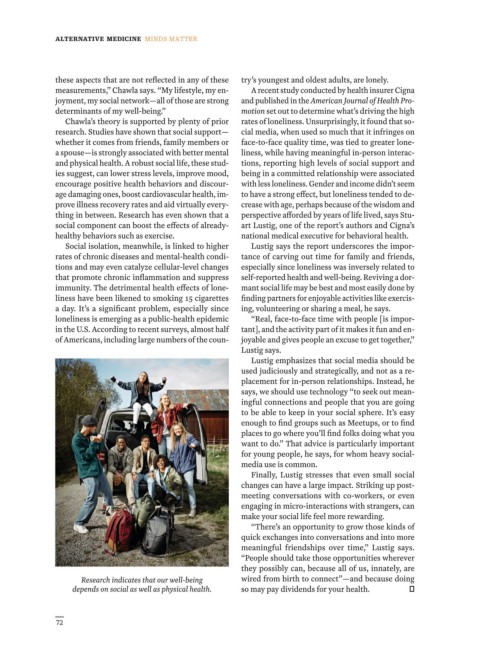
Research indicates that our well-being wired from birth to connect”—and because doing
depends on social as well as physical health. so may pay dividends for your health.
72

