


Page 80 - Time Special Edition Alternative Medicine (January 2020)
P. 80
ALTERNATIVE      MEDICINE MINDS MATTER


                   monarchs    should   live  longer  than  the  rest  of  us,
                   since millions of people pray for the health of their
                   King or Queen every day. His research showed just
                   the opposite—no surprise, perhaps, given the in-
                   dulgent diet and underlying stress of fending off
                   threats to the throne that royals must endure. An
                   oft- discussed 1988 study by cardiologist Randolph
                   Byrd of San Francisco General Hospital took a more

                   rigorous look at the same question and found that
                   heart patients who were prayed for fared better than
                   those who were not. But a larger study in 2005 by
                   cardiologist Herbert Benson at Harvard University
                   challenged that finding, reporting that complica-
                   tions occurred in 52% of heart-bypass patients who
                   received intercessory prayer and 51% of those who

                   didn’t—essentially a tie.
                      Such findings don’t typically dissuade  believers—
                   not  unexpectedly,    perhaps,   considering   the  cen-
                   trality of prayer to faith. But there is one thing on
                   which both camps agree: when you’re setting up
                   your study, it matters a great deal whether subjects
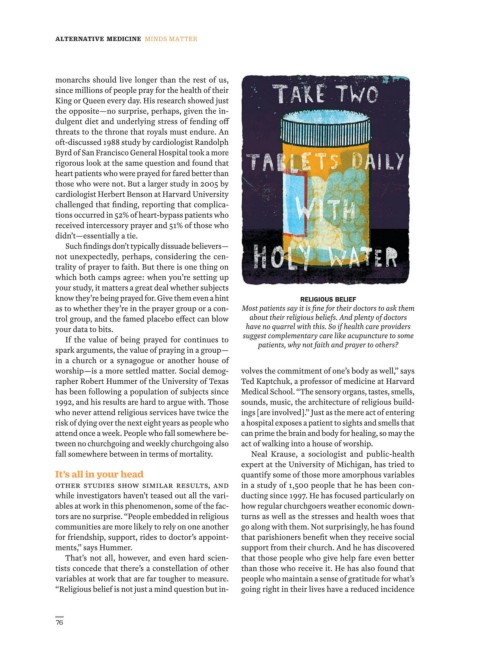
                   know they’re being prayed for. Give them even a hint                            RELIGIOUS BELIEF
                   as to whether they’re in the prayer group or a con-          Most patients say it is fine for their doctors to ask them
                   trol group, and the famed placebo effect can blow               about their religious beliefs. And plenty of doctors

                   your data to bits.                                            have no quarrel with this. So if health care providers
                      If  the  value  of  being  prayed  for  continues   to    suggest complementary care like acupuncture to some
                                                                                      patients, why not faith and prayer to others?
                   spark arguments, the value of praying in a group—
                   in  a  church  or  a  synagogue  or  another   house   of
                   worship—is a more settled matter. Social demog-              volves the commitment of one’s body as well,” says
                   rapher Robert Hummer of the University of Texas              Ted Kaptchuk, a professor of medicine at Harvard

                   has been following a population of subjects since            Medical School. “The sensory organs, tastes, smells,
                   1992, and his results are hard to argue with. Those          sounds, music, the architecture of religious build-
                   who never attend religious services have twice the           ings [are involved].” Just as the mere act of entering
                   risk of dying over the next eight years as people who        a hospital exposes a patient to sights and smells that
                   attend once a week. People who fall somewhere be-            can prime the brain and body for healing, so may the
                   tween no churchgoing and weekly churchgoing also             act of walking into a house of worship.
                   fall somewhere between in terms of mortality.                   Neal   Krause,   a  sociologist  and  public-health
                                                                                expert at the University of Michigan, has tried to
                   It’s all in your head                                        quantify some of those more amorphous variables

                   other    studies    shoW    similar     results,    and      in a study of 1,500 people that he has been con-
                   while investigators haven’t teased out all the vari-         ducting since 1997. He has focused particularly on
                   ables at work in this phenomenon, some of the fac-           how regular churchgoers weather economic down-
                   tors are no surprise. “People embedded in religious          turns as well as the stresses and health woes that
                   communities are more likely to rely on one another           go along with them. Not surprisingly, he has found
                   for friendship, support, rides to doctor’s appoint-          that parishioners benefit when they receive social
                   ments,” says Hummer.                                         support from their church. And he has discovered

                      That’s  not  all,  however,  and  even   hard  scien-     that those people who give help fare even better
                   tists concede that there’s a constellation of other          than those who receive it. He has also found that
                   variables at work that are far tougher to measure.           people who maintain a sense of gratitude for what’s
                   “Religious belief is not just a mind question but in-        going right in their lives have a reduced incidence


                   76

