


Page 81 - Time Special Edition Alternative Medicine (January 2020)
P. 81
quality of life and a greater sense that their doctors
cared about them.
Even doctors who aren’t familiar with Kristell-
er’s script are finding it easier to combine spiritual
care and medical care. HealthCare Chaplaincy is an
organization of Christian, Jewish, Muslim and Zen
Buddhist board-certified chaplains affiliated with
more than a dozen hospitals and clinics in the New
York City area. The group routinely provides pas-
toral care to patients as part of the total package of
treatment. The chaplains, like doctors, have a case-
load of patients they visit on their rounds, taking
what amounts to a spiritual history and either offer-
ing counseling on their own or referring patients to
others. The Rev. Walter Smith, former president and
CEO of the chaplaincy and an end-of-life specialist,
sees what the group offers as a health care product—
one that is not limited to believers.
“When people say, ‘I’m not sure you can help be-
cause I’m not very religious,’ ” Smith explains, “the
chaplains say, ‘That’s not a problem. Can I sit down
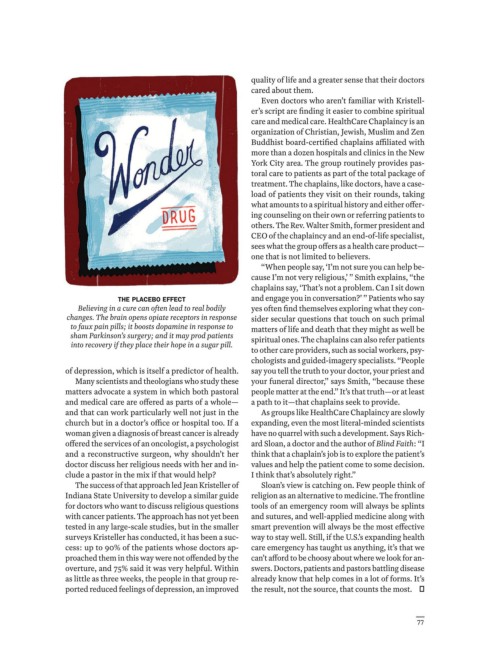
THE PLACEBO EFFECT and engage you in conversation?’ ” Patients who say
Believing in a cure can often lead to real bodily yes often find themselves exploring what they con-
changes. The brain opens opiate receptors in response sider secular questions that touch on such primal
to faux pain pills; it boosts dopamine in response to matters of life and death that they might as well be
sham Parkinson’s surgery; and it may prod patients spiritual ones. The chaplains can also refer patients
into recovery if they place their hope in a sugar pill.
to other care providers, such as social workers, psy-
chologists and guided-imagery specialists. “People
of depression, which is itself a predictor of health. say you tell the truth to your doctor, your priest and
Many scientists and theologians who study these your funeral director,” says Smith, “because these
matters advocate a system in which both pastoral people matter at the end.” It’s that truth—or at least
and medical care are offered as parts of a whole— a path to it—that chaplains seek to provide.
and that can work particularly well not just in the As groups like HealthCare Chaplaincy are slowly
church but in a doctor’s office or hospital too. If a expanding, even the most literal-minded scientists
woman given a diagnosis of breast cancer is already have no quarrel with such a development. Says Rich-
offered the services of an oncologist, a psychologist ard Sloan, a doctor and the author of Blind Faith: “I
and a reconstructive surgeon, why shouldn’t her think that a chaplain’s job is to explore the patient’s
doctor discuss her religious needs with her and in- values and help the patient come to some decision.
clude a pastor in the mix if that would help? I think that’s absolutely right.”
The success of that approach led Jean Kristeller of Sloan’s view is catching on. Few people think of
Indiana State University to develop a similar guide religion as an alternative to medicine. The frontline
for doctors who want to discuss religious questions tools of an emergency room will always be splints
with cancer patients. The approach has not yet been and sutures, and well-applied medicine along with
tested in any large-scale studies, but in the smaller smart prevention will always be the most effective
surveys Kristeller has conducted, it has been a suc- way to stay well. Still, if the U.S.’s expanding health
cess: up to 90% of the patients whose doctors ap- care emergency has taught us anything, it’s that we
proached them in this way were not offended by the can’t afford to be choosy about where we look for an-
overture, and 75% said it was very helpful. Within swers. Doctors, patients and pastors battling disease
as little as three weeks, the people in that group re- already know that help comes in a lot of forms. It’s
ported reduced feelings of depression, an improved the result, not the source, that counts the most.
77

