


Page 116 - (DK) Help Your Kids with Language Arts
P. 116
114 PUNCTU A TION
Parentheses – SEE ALSO
88–89 Direct and indirect speech
96–99 Commas
and dashes Numbers, dates, and time 118–119
106–107 Hyphens
Abbreviations 172–173
PARENTHESES AND DASHES INDICATE A STRONG
INTERRUPTION WITHIN A SENTENCE.
Parentheses and dashes allow writers to interrupt the
• Parentheses can be used around
normal run of a sentence and insert additional information.
an s to show that there may
Parentheses are always used in pairs around the extra text, be one or more of something:
while dashes can be used alone or in pairs. for example, “boy(s).”
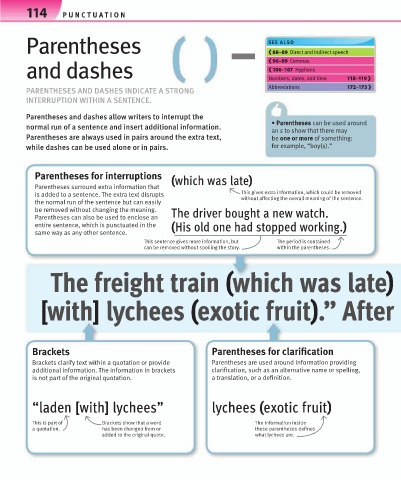
Parentheses for interruptions (which was late)
Parentheses surround extra information that
is added to a sentence. The extra text disrupts This gives extra information, which could be removed
without affecting the overall meaning of the sentence.
the normal run of the sentence but can easily
be removed without changing the meaning. The driver bought a new watch.
Parentheses can also be used to enclose an
entire sentence, which is punctuated in the (His old one had stopped working.)
same way as any other sentence.
This sentence gives more information, but The period is contained
can be removed without spoiling the story. within the parentheses.
The freight train (which was late)
[with] lychees (exotic fruit).” After
Brackets Parentheses for clarification
Brackets clarify text within a quotation or provide Parentheses are used around information providing
additional information. The information in brackets clarification, such as an alternative name or spelling,
is not part of the original quotation. a translation, or a definition.
“laden [with] lychees” lychees (exotic fruit)
This is part of Brackets show that a word The information inside
a quotation. has been changed from or these parentheses defines
added to the original quote. what lychees are.

