


Page 114 - (DK) Help Your Kids with Language Arts
P. 114
112 PUNCTU A TION
Exclamation points SEE ALSO
54–55 Voices and moods
EXCLAMATION POINTS ARE USED AT THE END 62–63 Interjections
68–69 Sentences
OF EXCLAMATIONS. 110–111 Question marks
Parentheses and dashes 114–115
An exclamation point indicates the end of an exclamation,
which is a sentence that expresses a writer’s strong
emotions. It can also be used for emphasis.
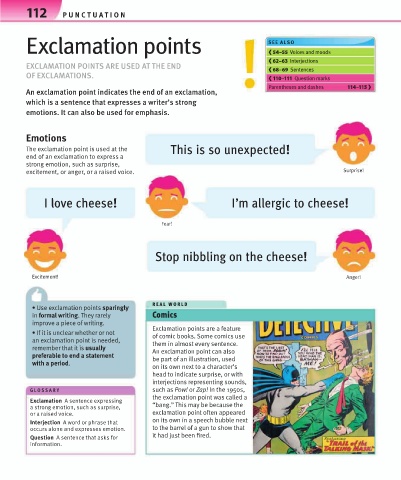
Emotions
The exclamation point is used at the This is so unexpected!
end of an exclamation to express a
strong emotion, such as surprise,
excitement, or anger, or a raised voice. Surprise!
I love cheese! I’m allergic to cheese!
Fear!
Stop nibbling on the cheese!
Excitement! Anger!
REAL W OR L D
• Use exclamation points sparingly
in formal writing. They rarely Comics
improve a piece of writing.
Exclamation points are a feature
• If it is unclear whether or not of comic books. Some comics use
an exclamation point is needed, them in almost every sentence.
remember that it is usually An exclamation point can also
preferable to end a statement be part of an illustration, used
with a period.
on its own next to a character’s
head to indicate surprise, or with
interjections representing sounds,
GLO S S A RY such as Pow! or Zap! In the 1950s,
the exclamation point was called a
Exclamation A sentence expressing
a strong emotion, such as surprise, “bang.” This may be because the
or a raised voice. exclamation point often appeared
Interjection A word or phrase that on its own in a speech bubble next
occurs alone and expresses emotion. to the barrel of a gun to show that
Question A sentence that asks for it had just been fired.
information.

