


Page 112 - (DK) Help Your Kids with Language Arts
P. 112
110 PUNCTU A TION
Question marks SEE ALSO
34–35 Pronouns
A QUESTION MARK SIGNALS THE END OF A SENTENCE 68–69 Sentences
88–89 Direct and indirect speech
THAT ASKS A QUESTION. 108–109 Quotation marks
Exclamation marks 112–113
Usually, a period is used to indicate the end of a sentence.
Italics 122–123
However, if the sentence is a question rather than a
statement, it should end with a question mark.
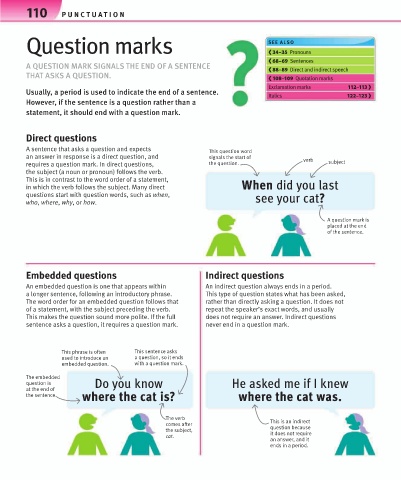
Direct questions
A sentence that asks a question and expects This question word
an answer in response is a direct question, and signals the start of verb
requires a question mark. In direct questions, the question. subject
the subject (a noun or pronoun) follows the verb.
This is in contrast to the word order of a statement,
in which the verb follows the subject. Many direct When did you last
questions start with question words, such as when, see your cat?
who, where, why, or how.
A question mark is
placed at the end
of the sentence.
Embedded questions Indirect questions
An embedded question is one that appears within An indirect question always ends in a period.
a longer sentence, following an introductory phrase. This type of question states what has been asked,
The word order for an embedded question follows that rather than directly asking a question. It does not
of a statement, with the subject preceding the verb. repeat the speaker’s exact words, and usually
This makes the question sound more polite. If the full does not require an answer. Indirect questions
sentence asks a question, it requires a question mark. never end in a question mark.
This phrase is often This sentence asks
used to introduce an a question, so it ends
embedded question. with a question mark.
The embedded
question is Do you know He asked me if I knew
at the end of
where the cat is? where the cat was.
the sentence.
The verb This is an indirect
comes after
the subject, question because
cat. it does not require
an answer, and it
ends in a period.

