


Page 234 - (DK) Help Your Kids with Language Arts
P. 234
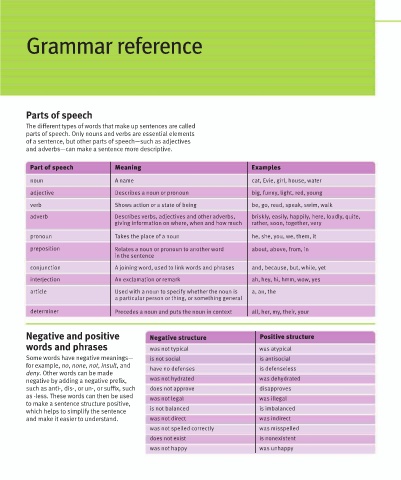
Grammar reference


        Parts of speech
        The different types of words that make up sentences are called
        parts of speech. Only nouns and verbs are essential elements
        of a sentence, but other parts of speech—such as adjectives
        and adverbs—can make a sentence more descriptive.

         Part of speech          Meaning                              Examples

         noun                    A name                               cat, Evie, girl, house, water
         adjective               Describes a noun or pronoun          big, funny, light, red, young
         verb                    Shows action or a state of being     be, go, read, speak, swim, walk
         adverb                  Describes verbs, adjectives and other adverbs,   briskly, easily, happily, here, loudly, quite,
                                 giving information on where, when and how much  rather, soon, together, very
         pronoun                 Takes the place of a noun            he, she, you, we, them, it
         preposition             Relates a noun or pronoun to another word    about, above, from, in
                                 in the sentence
         conjunction             A joining word, used to link words and phrases  and, because, but, while, yet
         interjection            An exclamation or remark             ah, hey, hi, hmm, wow, yes
         article                 Used with a noun to specify whether the noun is    a, an, the
                                 a particular person or thing, or something general
         determiner              Precedes a noun and puts the noun in context  all, her, my, their, your


        Negative and positive             Negative structure             Positive structure
        words and phrases                 was not typical                was atypical
        Some words have negative meanings—   is not social               is antisocial
        for example, no, none, not, insult, and   have no defenses       is defenseless
        deny. Other words can be made
        negative by adding a negative prefix,   was not hydrated          was dehydrated
        such as anti-, dis-, or un-, or suffix, such   does not approve    disapproves
        as -less. These words can then be used   was not legal           was illegal
        to make a sentence structure positive,
        which helps to simplify the sentence   is not balanced           is imbalanced
        and make it easier to understand.   was not direct               was indirect
                                          was not spelled correctly      was misspelled
                                          does not exist                 is nonexistent
                                          was not happy                  was unhappy

