


Page 229 - (DK) Help Your Kids with Language Arts
P. 229
227
                                                                       WRITING A SPEE CH


        Smooth talker
                                                            Emotive and sensational language
        Speechwriters use particular techniques to create
        interesting speeches that will engage an audience.    A speech isn’t just a list of events or a logical argument.
        Most importantly, they consider what the words will    It needs to appeal to the audience. Speechwriters use
        sound like when they are spoken out loud.           emotive language to evoke a response in the audience,
                                                            such as sympathy, guilt, or excitement.

           Rhetorical questions
           Sometimes, a speaker will ask the audience           Every year, thousands and thousands
           a question, often without expecting an answer.        of untouched Brussels sprouts are
           Posing questions makes listeners feel involved and
           encourages them to think about something in depth.   thoughtlessly dumped in the trash.


                                                           Pronouns
           You say that you hate Brussels sprouts, but
                                                           Using the pronouns I, you, or we in a speech can make
               have you ever given them a chance?          it more personal. Speakers also use friendly terms of
                                                           address, such as friends or comrades, to relate to
                                                           the audience.
          Repetition and lists
          Repeating words and phrases gives a speech a good
          rhythm and emphasizes important words and ideas.   I changed my mind about Brussels sprouts.
          Patterns of three are particularly common in speech   You can, too. Together we can make this
          writing. Listing subjects, places, or names can reinforce
          how many there are of something.                           vegetable popular again.


               Sprouts are bursting with goodness.          Slogans
           They are packed with vitamin C, vitamin A,       Speeches often contain memorable statements called
             potassium, calcium, iron, and protein.         slogans, which sum up an argument. They are usually
                                                            short and powerful, and sound good when spoken out
                                                            loud, often because they use alliteration.
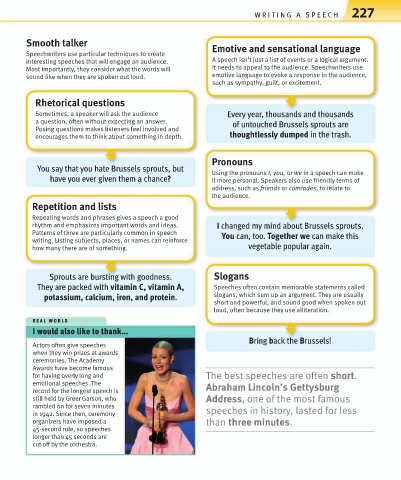
          REAL  W OR L D
          I would also like to thank…
                                                                      Bring back the Brussels!
          Actors often give speeches
          when they win prizes at awards
          ceremonies. The Academy
          Awards have become famous
          for having overly long and                      The best speeches are often short.
          emotional speeches. The
          record for the longest speech is                Abraham Lincoln’s Gettysburg
          still held by Greer Garson, who                 Address, one of the most famous
          rambled on for seven minutes
          in 1942. Since then, ceremony                   speeches in history, lasted for less
          organizers have imposed a                       than three minutes.
          45-second rule, so speeches
          longer than 45 seconds are
          cut off by the orchestra.

