


Page 11 - (DK) Ocean - The Definitive Visual Guide
P. 11
FOREWORD


                                                                            e should call our planet Ocean. A small orb
                                                                      Wfloating in the endless darkness of space, it is
                                                                      a beacon of life in the otherwise forbidding cold of
                                                                      the endless universe. Against all odds, it is also the
                                                                      Petri dish from which all life known to us springs.
                                                                        Without water, our planet would be just one of
                                                                      billions of lifeless rocks floating endlessly in the
                                                                      vastness of the inky-black void. Even statisticians
                                                                      revel in the improbability that it exists at all, with
                                                                      such a rich abundance of life, much less that we as a
                                                                      species survive on its surface. Yet, despite the maze
                                                                      of improbability, we have somehow found our way
                                                                      to where we are today. Humans were enchanted by the sea even before the
                                                                      Greek poet Homer wrote his epic tale of ocean adventure, the Odyssey. It is
                                                                      this fascination that has driven us to delve into this foreign realm in search of
                                                                      answers, but the sea has always been reluctant to give up its secrets easily.
                                                                      Even with the monumental achievements of past explorers, scientists, and
                                                                      oceanographers, we have barely ventured through its surface.
                                                                        It is estimated that over 90 percent of the world’s biodiversity resides in its
                                                                      oceans. From the heartbeat-like pulsing of the jellyfish to the life-and-death
                                                                      battle between an octopus and a mantis shrimp, discoveries await us at every
                                                                      turn. And for every mystery solved, a dozen more present themselves. These
                                                                      are certainly exciting times as we dive into the planet’s final frontier. Aided
                                                                      by new technology, we can now explore beyond the two percent or so of the
                                                                      oceans that previous generations observed. But even with the advent of
                                                                      modern technology, it will take several more generations to achieve a
                                                                      knowledge base similar to the one we have about the land.
                                                                        No matter how remote we feel we are from the oceans, every act each
                                                                      one of us takes in our everyday lives affects our planet’s water cycle and in
                                                                      return affects us. All the water that falls on land, from the highest peaks to the
                                                                      flattest plains, ends up draining into the oceans. And although this has
                                                                      happened for countless millions of years, the growing ecological footprint of
                                                                      our species in the last century has affected the cycle in profound ways. From
                                                                      fertilizer overuse in landlocked areas, which creates life-choking algal blooms
                                                                      thousand of miles away, to everyday plastic items washing up in even the
                                                                      most remote areas of the globe, our actions affect the health of this, our sole
                                                                      life-support system.
                                                                        This statement is not here to make us feel that we are doomed by our
                                                                      actions, but rather to illustrate that through improved knowledge of the
                                                                      ocean system and its inhabitants, we can become impassioned to work
                                                                      toward curing our planet’s faltering health. By taking simple steps, such as
                                                                      paying a little more attention to our daily routines, each one of us can have
                                                                      a significant positive impact on the future of our planet and on the world our
                                                                      children will inherit. In short, it would be much healthier for us to learn to
                                                                      dance nature’s waltz than to try to change the music.


                                                                                                                  Fabien Cousteau
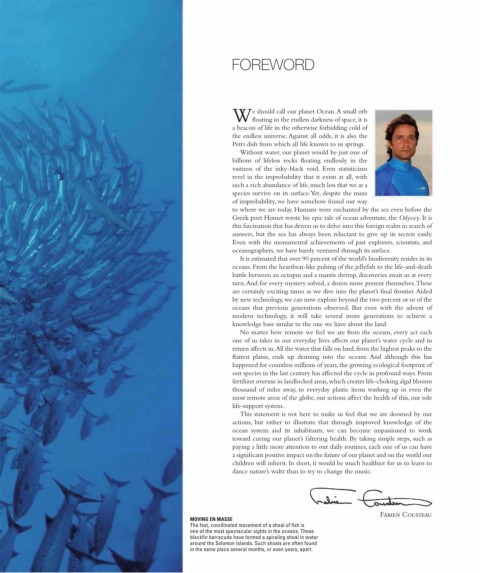
                                                          MOVING EN MASSE
                                                          The fast, coordinated movement of a shoal of fish is
                                                          one of the most spectacular sights in the oceans. These
                                                          blackfin barracuda have formed a spiraling shoal in water
                                                          around the Solomon Islands. Such shoals are often found
                                                          in the same place several months, or even years, apart.

