


Page 8 - (DK) Ocean - The Definitive Visual Guide
P. 8
6
About this Book Ocean Environments
This chapter looks at specific parts of the oceans. It is divided into sections
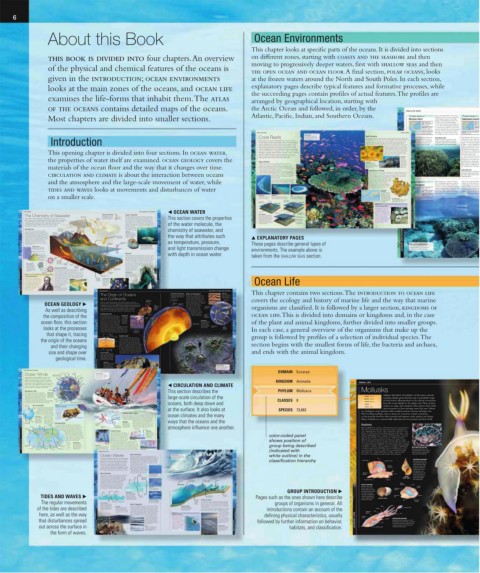
THIS BOOK IS DIVIDED INTO four chapters. An overview on different zones, starting with coasts and the seashore and then
moving to progressively deeper waters, first with shallow seas and then
of the physical and chemical features of the oceans is
the open ocean and ocean floor. A final section, polar oceans, looks
given in the introduction; ocean environments at the frozen waters around the North and South Poles. In each section,
looks at the main zones of the oceans, and ocean life explanatory pages describe typical features and formative processes, while
the succeeding pages contain profiles of actual features. The profiles are
examines the life-forms that inhabit them. The atlas arranged by geographical location, starting with
of the oceans contains detailed maps of the oceans. the Arctic Ocean and followed, in order, by the 160 SHALLOW SEAS
Most chapters are divided into smaller sections. Atlantic, Pacific, Indian, and Southern Oceans. Shiraho Reef species concentrated in a few square Tubbataha Reefs
PACIFIC OCEAN WEST
PACIFIC OCEAN WEST
kilometres. The reef also contains the
world’s largest colony of rare Blue
TYPE Fringing reef Ridge Coral (Heliopora coerulea). For TYPE Atol
decades, environmentalists battled
AREA 10 square km to save the reef from the building of AREA 330
(4 square miles) a new airport for Ishigaki. A proposal (130 squar
CONDITION Reasonable; to construct the airport on top of the CONDITION
damaged in parts by reef was dropped, but concern remains recovering
bleaching in 1998, 2007 now that it has been built on land, as bleaching
153
152 SHALLOW SEAS CORAL REEFS LOCATION Southeast coast of Ishigaki Island, at the discharge of excavated soil into the LOCATION Central Sulu Sea, between t
southwestern extremity of Japanese archipelago and northern Borneo
CORAL DIVERSITY reef is likely to have an adverse effect.
Coral Reefs In this seascape off a Fijian island, Reef Formation BLUE RIDGE CORAL The Tubbataha Reefs lie arou
groups of shoaling sea goldies hover
The individual animals that make up corals are called polyps. The polyps of the main group Shiraho Reef, off Ishigaki Island, part
over diverse species of coral, sponges,
Introduction CORAL REEFS ARE SOLID STRUCTURES built from the remains The polyps also form colonies that create community skeletons in a variety of shapes. An notice in the 1980s as an outstanding varies from violet through blue, turquoise, are famous for the many larg
Despite its name, the colour of this coral
atolls in the centre of the Sul
and other reef organisms.
of reef-building corals, stony corals, secrete limestone, building on the substrate underneath. of the Japanese archipelago, came to
(open ocean) marine animals
of small marine organisms, principally a group of colony-forming
important contributor to the life of these corals is the presence within the polyps of tiny
example of biodiversity, with some
and green to yellow-brown. Its branching
organisms called zooxanthellae, which provide much of the polyps’ nutritional needs.
animals called stony (or hard) corals. Reefs cover about 108,000
turtles, and barracuda. The ste
Grazing and boring organisms also contribute, by
square miles (280,000 square km) of the world’s shallow marine Other organisms that add their skeletal remains to the reef include mollusks and echinoderms. 120 species of coral and 300 fish vertical plates can form massive colonies. to them – such as sharks, Ma
areas, growing gradually as the organisms that form their living breaking coral skeletons into sand, which fills gaps shelving reefs here are also ri
in the developing reef. Algae and other encrusting
surfaces multiply, spread, and die, adding their limestone skeletons organisms help bind the sand and coral fragments smaller life, including many s
This opening chapter is divided into four sections. In ocean water, to the reef. Coral reefs are among the most complex and beautiful together. Most reefs do not grow continuously but of crustaceans, colourful nud
experience spurts of growth interspersed with
of Earth’s ecosystems, and are home to a fantastic variety of animals
(sea slugs), and more than 35
and other organisms; but they are also among the most heavily
quieter periods, which are sometimes associated
of stony and soft coral.
utilized and economically valuable. Today, the world’s reefs are with recovery from storm damage. STONY CORAL Reefs were rated by scuba di
In the early 1990s, the Tub
under pressure from numerous threats to their health.
the properties of water itself are examined. ocean geology covers the branching hard among the top ten dive sites
This group of
corals is growing
Types of Reefs
world. However, during the
at a depth of about
At the center of each polyp is
coast of eastern
Coral reefs fall into three main types: fringing reefs, barrier reefs, and OPEN POLYPS 16 ft (5 m) off the they suffered considerable da
from destructive fishing pract
Indonesia. Individual
an opening, the mouth, which
materials of the ocean floor and the way that it changes over time. with little or no separation from the shore, and develop through upward around the gut secretes limestone, grow up to a few the establishment of a seawee
atolls. The most common are fringing reefs. These occur adjacent to land,
leads to an internal gut. The tissue
stony corals can
growth of reef-forming corals on an area of continental shelf. Barrier reefs
inches per year.
which builds the reef.
are broader and separated from land by a stretch of water, called a lagoon, that
can be many miles wide and dozens of yards deep. CORAL DROP-OFF
Atolls are large, ring-shaped reefs, enclosing a central lagoon; most atolls Distribution of Reefs In this photograph of a steeply she
are found well away from large landmasses, such as in the South Pacific. Parts
circulation and climate is about the interaction between oceans of the reef structure in both atolls and barrier reefs often protrude above sea at least 64˚F (18˚C), and preferably 77–84˚F (25–29˚C). They grow best where the reef slope, several species of soft
Stony corals can grow only in clear, sunlit, shallow water where the temperature is
are visible, together with a shoal o
average salinity of the water is 36 ppt (parts per thousand) and there is little wave
level as low-lying coral islands—these develop as
Longfin Bannerfish.
action or sedimentation from river runoff. These conditions occur only in some
wave action deposits coral fragments broken off
from the reef itself. tropical and subtropical areas. The highest concentration
Two other types of reefs are patch reefs—small of coral reefs is found in the Indo-Pacific region,
which stretches from the Red Sea to the central
structures found within the lagoons of other reef
and the atmosphere and the large-scale movement of water, while types—and bank reefs, comprising various reef Pacific. A smaller concentration of reefs occurs PACIFIC OCEAN WEST Nusa Tenggara is a chain of around indicate an extremely high d
marine life in this region. Fo
structures that have no obvious link to a coastline.
500 coral-fringed islands in southern
around the Caribbean Sea. In addition to
warm-water reefs, awareness is growing about
other corals that do not depend on sunlight, Nusa Tenggara Indonesia. The northern islands are a single large reef can contai
and form deep, cold-water reefs—some of TYPE Fringing reefs, volcanic in origin, while the southern than 1,200 species of fish (m
tides and waves looks at movements and disturbances of water WARM-WATER barrier reefs islands consist mainly of uplifted coral in all the seas in Europe com
them outside the tropics (see p.178).
limestone. Many of the reefs have
and 500 different species of
REEF AREAS
AREA 5,000 square km
The conditions needed for (2,000 square miles) been only rarely explored. However, building coral. Common ani
the growth of warm-water CONDITION Damaged by what surveys have been carried out include Eagle Rays, Manta R
on a smaller scale. FRINGING REEF BARRIER REEF ATOLL An atoll is a ring of coral reefs or coral within tropical areas of the COLD-WATER CORAL LOCATION Southern Indonesia, from Lombok in the
coral reefs are found mainly
fishing practices
Indian, Pacific, and Atlantic
A barrier reef is separated from the coast by a
A fringing reef directly borders the
islands enclosing a central lagoon. It
shore of an island or large
lagoon. In this aerial view, the light blue area is the
oceans. The reefs are chiefly
in the western parts of these
landmass, with no deep lagoon.
reef and the distant dark blue area is the lagoon.
may be elliptical or irregular in shape.
oceans, where the waters This species, Lophelia pertusa, is one of a few west to Timor in the east
island subsides are warmer than in the of the reef-forming corals that grow in cold
coral grows on sea level when volcano has
shoreline, forming become inactive eastern areas. water, at depths to 1,650 ft (500 m).
fringing reef BARRIER REEF
FRINGING REEF HUMAN IMPACT
CORAL BLEACHING
reef-building corals and occurs
when the tiny organisms called
32 OCEAN WATER THE CHEMISTRY OF SEAWATER 33 ◀ OCEAN WATER OCEAN ENVIRONMENTS ATOLL FORMATION lagoon of lagoon reef face coral continues Bleaching refers to color loss in
zooxanthellae, which give corals
volcanic
their colors, are ejected from coral
island
shallow water
to grow, forming
polyps or lose their pigment. In
barrier reef
The Chemistry of Seawater volcanic ash drifts SOURCES, SINKS, AND EXCHANGES KEY gases Gases in Seawater An atoll is shown here forming around a ATOLL volcanic island extreme cases, this can lead to the OCEAN ENVIRONMENTS
Shown here are various sources, sinks,
and exchange processes for the ions,
coral’s death. Various stresses
volcanic island. First, the island’s shore is
The main gases dissolved in seawater are nitrogen (N), oxygen (O 2 ),
down to sea salts, and minerals (yellow arrows), ions, salts, and and carbon dioxide (CO 2 ). The levels of O 2 and CO 2 vary in response colonized by corals forming a fringing reef becomes submerged can cause bleaching, including
minerals
(turquoise arrows) in seawater.
THE OCEANS CONTAIN MILLIONS OF DISSOLVED chemical substances. Most of spread of volcanic ash gases (pink arrows), and plant nutrients plant nutrients to the activities of photosynthesizing organisms (phytoplankton) and This section covers the properties (above). Over time, the island subsides, but central area filled pollution, ocean temperature rise,
and ocean acidification (see p.67).
and gases into
coral growth continues, forming a barrier
these are present in exceedingly small concentrations. Those present in significant rain clouds animals. The level of O 2 is generally highest near the surface, where the reef (above right). Finally, the island by reef limestone In recent decades, some mass
gas is absorbed from the air and also produced by photosynthesizers.
concentrations include sea salt, which is not a single substance but a mixture Its concentration drops to a minimum in a zone between about 660 ft disappears, but the coral maintains growth, coral continues bleaching events have affected
of charged particles called ions. Other constituents include gases such (200 m) and 3,300 ft (1,000 m), where oxygen is consumed by bacterial of the water molecule, the forming an atoll (right). Atolls can also form to grow where reefs over wide areas.
as a result of sea-level rise.
waves bring food
oxidation of dead organic matter and by animals feeding on this matter.
as oxygen and carbon dioxide. One reason the oceans contain so Deeper down, the O 2 level increases again. CO 2 levels are highest at depth
many dissolved substances is that water is an excellent solvent.
and lowest at the surface,
where the gas is taken up by
The Salty Sea salts are leached photosynthesizers faster than chemistry of seawater, and
from rocks into rivers
it is produced by respiration.
The salt in the oceans exists in the form of charged and streams and salt spray
flow to ocean
onto land
particles, called ions, some positively charged and some CARBON SINK
negatively charged. The most common of these are sodium nutrients from Many marine animals, such as
soil wash into
nautiluses (below), use carbonate
and chloride ions, the components of ordinary table salt rivers and streams, (a compound of carbon and oxygen)
and flow to ocean
(sodium chloride). Together they make up about 85 percent in seawater to make their shells.
by mass of all the salt in the sea. Nearly all the rest is made washing of ions After they die, the shells may form the way that attributes such OCEAN ENVIRONMENTS
from volcanic dust
up of the next four most common ions, which are sulfate, and gases into sea, sediments and eventually rocks. ▲ EXPLANATORY PAGES
dissolved in rain
magnesium, calcium, and potassium. All these ions, together
with several others present in smaller quantities, exist dust blown off land
throughout the oceans in fixed proportions. Each is
distributed extremely uniformly—this is in contrast to exchange of gases as temperature, pressure,
some other dissolved substances in seawater, which are exchange of gases between ocean and These pages describe general types of
unevenly distributed. between animals atmosphere REEF FLAT OFF PANTAR ISLAND
and seawater
OXYGEN PRODUCER AND CONSUMER This shallow reef area, featuring
BREAKDOWN OF SALT Oxygen levels in the upper ocean depend
If 2½ gallons (10 liters) of seawater are on the balance between its production by numerous species of stony coral and
evaporated, about 12 3 / 4 oz (354 g) of salts photo-synthesizing organisms, such as kelp, and light transmission change a starfish, is in east Nusa Tenggara.
and its consumption by animals, such as fish.
are obtained, of the types shown below. environments. The example above is
2½ gallons (10 liters) of seawater
Nutrients
other salts 1 /4oz (7.5g) Numerous substances present in small amounts in seawater are essential with depth in ocean water.
calcium sulfate taken from the SHALLOW SEAS section.
(gypsum) 2 /3oz (17.7g) for marine organisms to grow. At the base of the oceanic food chain are
magnesium salts +
2oz (54.8g) + + sodium ion (positive phytoplankton—microscopic floating life-forms that obtain energy by
photosynthesis. Phytoplankton need substances such as nitrates, iron, and
sodium chloride – charge)
(halite) – – phosphates in order to grow and multiply. If the supply of these nutrients
10oz (274g) + – Na + – + slow uplift of dries up, their growth stops; conversely, blooms (rapid growth phases)
sedimentary rocks
– – – at continental occur if it increases. Although the sea receives some input of nutrients
+ + margins, exposing from sources such as rivers, the main supply comes from a continuous
WATER AS A SOLVENT + salts, minerals, uptake of nutrient cycle within the ocean. As organisms die, they sink to the ocean floor,
and ions at surface
nutrients by
The charge imbalance on its phytoplankton upwelling where their tissues decompose and release nutrients. Upwelling of seawater
molecules makes water a good –
solvent. When dissolving and – – exchange of from the ocean floor (see p.60)
gases between
holding sodium chloride in + phytoplankton recharges the surface waters with
solution, the positive ends of + + Sources and Sinks and seawater sinking and vital substances, where they are
the molecules face the chloride sodium chloride – + Cl – + – The ions that make up the salt in the oceans have arrived decomposition release of minerals taken up by the phytoplankton,
from hydrothermal
crystal
ions and the negative ends face + + + there through various processes. Some were dissolved out of of dead vents refueling the chain.
the sodium ions. water molecule – – rocks on land by the action of rainwater and carried to the organisms
chloride ion dissolving of PLANKTON BLOOM
(negative charge) – sea in rivers. Others entered the sea in the emanations of hydrothermal minerals from This satellite image of the
vents (see p.188), in dust blown off the land, or came from volcanic ash. sea floor Skagerrak (a strait linking the North
PEOPLE There are also “sinks” for every type of ion—processes that remove them precipitation of minerals and Baltic seas) shows a bloom of
phytoplankton, visible as a turquoise
ALEXANDER MARCET from seawater. These range from salt spray onto land to the precipitation onto sea floor discoloration in the water.
of various ions onto the seafloor as mineral deposits. Each type of ion
The Swiss chemist and doctor Alexander has a characteristic residence time. carbonates SILICEOUS DIATOMS
incorporated
Marcet (1770–1822) carried out some of the This is the time that an ion remains into seafloor These tiny forms of Ocean Life
planktonic organisms
sediments from
earliest research in marine chemistry. He is
INTRODUCTION the main chemical ions in seawater (such as have long residence times, ranging 42 OCEAN GEOLOGY INTRODUCTION THE ORIGIN OF OCEANS AND CONTINENTS 43
in seawater before it is removed.
have cell walls made
animal shells
best known for his discovery, in 1819, that all
The common ions in seawater
of silicate. They can
sodium, chloride, and magnesium ions) are
only grow if there are
from a few hundred years to
present in exactly the same proportions
sufficient amounts
of silica present
throughout the world’s oceans. The
hundreds of millions of years.
in the water.
unchanging ratio between the ions holds
true regardless of any variations in the
RIVER DISCHARGE
River discharge is a mechanism by which ions
salinity of water and is known
of sea salt and nutrients enter the oceans.
today as the principle of
Here, the Noosa River empties into the sea on
constant proportions.
the coast of Queensland, Australia.
The Origin of Oceans DEVELOPMENT OF CONTINENTAL CRUST Water and Atmosphere BANDED IRON This chapter contains two sections. The introduction to ocean life
Modification of the crust above rising mantle
Known as a banded-iron
flows was delayed by the continuous intrusion
formation, this layered rock
During the process of differentiation, volatile
of mantle basalt, resulting in the greenstone
formed as the oxygen content
belts found today at the heart of each materials were expelled from Earth’s interior contains iron oxides that
and Continents zircon crystals, greenstone belts above hydrogen and helium, would quickly have been rivers erode and covers the ecology and history of marine life and the way that marine
of early oceans increased.
by volcanic activity. The lightest gases, such as
continental shield.
lost to space, leaving a stable atmosphere of
rising mantle flow
transport sediment
nitrogen, carbon dioxide, and water vapor. Some
OCEAN GEOLOGY ▶ EARTH’S OCEANS FORMED MORE THAN 4 billion years ago, mainly from continental crust ZIRCON primitive basalt continuously crust pulled apart of the water vapor would have condensed to form
among the earliest
materials
water vapor that condensed from its primitive atmosphere but also from water
liquid water, and it seems there was a significant
intrudes from
ocean earlier than 4 billion years ago.
by convective
mantle
motion in mantle
brought from space by comets. Initially, after acquiring a layered internal structure,
Some meteorites contain 15-20 percent
thickens above
the Earth had a uniform crust that was enriched in lighter elements and floated continental crust water and the early Earth is thought ocean water from
volcanic eruptions
on an upper mantle made of denser materials. Later, the crust became sinking mantle to have had the same composition, and comet organisms are classified. It is followed by a larger section, kingdoms of
impacts
flow, without
providing an ample source for the
As well as describing differentiated into two types as continents began to form, made from mantle interference early ocean. More water arrived
rocks that were chemically distinct from those underlying the oceans.
with impacting comets. It was in
the ocean that free oxygen first
Continental Crust sedimentary appeared, with the arrival traces of early
the composition of the The continents include a wide range of rock THE OLDEST ROCKS rocks around 3.5 billion years ago. meteorite ocean life. This is divided into domains or kingdoms and, in the case
of photo- synthesizing life
and comet
These sedimentary
bombardment
types, including granitic igneous rocks, sedimentary
rocks, and the metamorphic rocks formed by the rocks on Baffin Island primitive gradually erased
oceanic
alteration of both. They contain a lot of quartz, a lie on the Canadian crust
Shield. The stable
mineral absent in oceanic crust. The first continental continental shields THE EARLY EARTH
ocean floor, this section rocks were the result of repeated melting, cooling, contain the world’s mantle Earth had deep oceans from of the plant and animal kingdoms, further divided into smaller groups.
an early stage, with volcanoes
and remixing of oceanic crust, driven by volcanic
most ancient rocks,
which are around
activity above mantle convection cells, which were
much more numerous and vigorous than today’s. 4 billion years old. vigorous convection and an increasing area of
continental crust standing
cells in upper mantle
Each cycle left more of the heavier components in above the surface. The ocean rifts occur when
became salty as weathering
looks at the processes the upper mantle and concentrated more of the lighter components in of surface rocks added fragments of crust volcanic
eruptions
move apart
the crust. The first microcontinents grew as lighter fragments of crust
minerals to the water.
add gases and
water vapor to
collided and fused. Thickening of the crust led to melting at its base
and underplating with granitic igneous rocks. Weathering accelerated atmosphere In each case, a general overview of the organisms that make up the
the process of continental rock formation, retaining the most resistant volcanic activity liquid outer core
adds igneous rocks
components, such as quartz, while washing solubles into the ocean. to surface above
that shape it, tracing basaltic lava rift basalt sheets
rising flows
(dikes)
sediment
ocean Oceanic Crust
surface The oceanic crust has a higher density than the solid inner core group is followed by profiles of a selection of individual species. The
the origin of the oceans ocean continental crust, making it less buoyant. Both types
of crust can be thought of as floating on the “plastic”
upper mantle, and the oceanic crust lies lower due to
gabbro crust its lower buoyancy. It is relatively thin, with a depth
peridotite of never more than 7 miles (11 km), compared with a
thickness of 15–43 miles (25–70 km) for most continental section begins with the smallest forms of life, the bacteria and archaea,
and their changing lithosphere crust. It consists mainly of basalt, an igneous rock that is
low in silica compared with continental rocks, and richer
Moho in calcium than the mantle. Basalt lava is created when
hot material in the upper mantle is decompressed, allowing
magma top layer it to melt and form liquid magma. The decompression
asthenosphere rises to surface of upper mantle occurs beneath rifts in the crust, such as those found at the
size and shape over OCEAN-FLOOR STRUCTURE mid-ocean ridges, and it is through these rifts that lava is and ends with the animal kingdom.
extruded onto the surface to create new ocean crust.
Three layers of basalt in the crust (basaltic
lava, dikes, and gabbro) are separated from
the mantle by the Mohorovic ˇic ´ discontinuity
(the Moho). The top layer of the upper mantle
geological time. rigid lithosphere, which makes up tectonic
is fused to the base of the crust to form the
plates.The asthenosphere is the soft zone
over which the plates of the lithosphere glide.
INTRODUCTION MANTLE ROCKS ANDEAN VOLCANOES INTRODUCTION
Peridotite is the dominant rock type
found in the mantle, consisting of
silicates of magnesium, iron, and
This radar image shows volcanoes
other metals. Sometimes it is
formed from andesite lava, whose
brought to the surface when parts
oceanic and continental rocks.
here in Newfoundland, Canada, or
as fragments from volcanic activity.
54 CIRCULATION AND CLIMATE of the ocean floor are uplifted, as 55 composition is intermediate between DOMAIN Eucarya
Ocean Winds polar-front jet stream—narrow polar easterly polar cell air rises in LONG-HAUL SAILING
subpolar
latitudes
Winds can blow with a consistent
strength and direction over large areas of
ribbon of strong wind at high Ferrel cell
THE PATTERN OF AIR MOVEMENT over the oceans altitude at top of front air descends ocean. Consequently, on long-haul sailing
trips, the same basic sail settings can
results from solar heating of the atmosphere and southwesterly in subtropical often be used for days on end.
latitudes
wind
Earth’s rotation. This pattern of winds is modified by Hadley
linked areas of low and high pressure (cyclones and cell KINGDOM Animalia
anticyclones), which continually move over the oceans’ air rises 276 ANIMAL LIFE
surface. Near coasts, additional onshore and offshore at equator ◀ CIRCULATION AND CLIMATE
breezes are common. These are caused by differences
in the capacity of sea and land to absorb heat.
direction of Mollusks
Atmospheric Cells Earth’s spin This section describes the PHYLUM Mollusca
Solar heating causes the air in Earth’s atmosphere to CIRCULATION CELLS
cycle around the globe in three sets of giant loops, The atmospheric cells
produce north–south
called atmospheric cells. Hadley cells are produced by airflows. These are north-
warm air rising near the equator, cooling in the upper modified by Earth’s easterly DOMAIN Eucarya AMONG THE MOST SUCCESSFUL of all marine animals,
spin, producing winds
atmosphere, and descending to the surface around that blow diagonally. trade wind large-scale circulation of the
subtropical latitudes (30˚N and S). Then the air moves mollusks display great diversity and a remarkable range
back toward the equator. Ferrel cells are produced by subtropical southeasterly KINGDOM Animalia
trade wind
jet stream
air rising around subpolar latitudes (60˚N and S), cooling and falling in polar-front jet CLASSES 8 of body forms, allowing them to live almost everywhere
the subtropics, and then moving toward the poles. Polar cells are caused stream PHYLUM Mollusca
by air descending at the poles and moving toward the equator. air descends trade winds meet at Intertropical
at pole Convergence Zone oceans, both deep down and from the ocean depths to the splash zone. They include
initial direction DISCOVERY CLASSES 8
of air The Coriolis Effect
movement SATELLITE IMAGING oysters, sea slugs, and octopuses. Most species have shells
air The atmospheric cells cause north–south SPECIES 73,683
deflected
to right air movements. These are altered by the Ocean winds are monitored and are passive or slow-moving; some lack eyes. Others
Coriolis effect. As the Earth spins, parcels of by instruments called at the surface. It also looks at SPECIES 73,683
air at different latitudes in the atmosphere scatterometers, such
have different west-to-east velocities (air at as an instrument are intelligent, active hunters with complex nervous systems and large eyes.
the Equator moves fastest). When they change called ASCAT on air ascends Pressure-system Winds
from cyclone
latitude by moving to the north or south, they the METOP-A warm air rising Filter-feeding mollusks, such as clams, are crucial to coastal ecosystems,
retain these west-to-east velocities, which differ satellite (right). air descends into In any area of ocean where air sinks—often at subtropical latitudes—a zone of ocean climates and the many
A scatterometer
high atmospheric pressure, or anticyclone, develops. Where warm air rises, areas
from those of air in the
anticyclone
AIR DEFLECTIONS is a radar device low pressure as they provide food for other animals and improve water quality and clarity.
In the Northern Hemisphere, latitudes they move into. that can measure ASCAT antenna at center central area of of low pressure, called cyclones or depressions, occur. These often develop near
high pressure
Hence, the air veers to
the equator and subpolar latitudes. Cyclones and anticyclones create linked,
the Coriolis effect causes both wind speed (one of three)
all air movements to be the east (in the direction and direction. cold air sinks circulating wind patterns, which continually move and change. In the Northern Many mollusks are commercially important for food, pearls, and their shells.
Earth’s air deflected to the right of of Earth’s spin) when Hemisphere, there is a clockwise movement of air
rotation deflected their initial direction. In moving away from the around an anticyclone, and a counterclockwise motion ways that the oceans and the
initial direction to left the Southern Hemisphere, Equator and to the west Prevailing Winds CYCLONES AND around a cyclone. This pattern is reversed in the
ANTICYCLONES
Air moves from an area of
they veer to the left.
of air movement when moving toward it. The winds produced by pressure differences and modified by the air spirals around central high pressure toward one Southern Hemisphere. Local pressure systems can affect
the general pattern of prevailing winds. In particular,
northeasterly area of low of low pressure, but the Anatomy
polar monsoon Coriolis effect are called the prevailing winds. In the tropics and pressure air moving from Coriolis effect modifies this, cyclones move swiftly over the ocean and can produce
north- westerlies (Nov–Mar) cold air flows high to low pressure
westerlies easterlies subtropics, the air movements toward the equator in Hadley cells are toward area of low deflected by Coriolis producing circular winds. rapid changes in wind strength and direction. atmosphere influence one another.
northeasterly deflected to the west. These are known as trade winds. They pressure effect to form spiral warm air cools Most mollusks have a head, a soft body mass, and a muscular foot.
trade winds comprise the northeasterly trades in the Northern at high altitude cold air sinks The foot is formed from the lower body surface and helps it to
Hemisphere, and southeasterly trades in the south.
At higher latitudes, the surface winds in Ferrel Coastal Breezes DAY AND NIGHT move. Mollusks have what is called a hydrostatic skeleton—their
Land heats up faster
cells deflect to the east, producing the westerlies. Local winds, called onshore and offshore than water during the day.
Tropic of Cancer In the Southern Hemisphere, these winds breezes, are generated near coasts, especially in air heats up Warm air rises over the land bodies are supported by internal fluid pressure rather than a hard
and rises over cool air
blow from west to east without meeting land. sunny climes. Onshore breezes—sometimes land drawn in and draws in cold air from color-coded panel
the sea. At night, the land
Those around latitudes of 40˚S are known as called sea breezes—develop during the day. skeleton. All mollusks have a mantle, a body layer that covers the
reversing the airflow.
Intertropical Convergence Zone equator the Roaring Forties. In polar regions, winds These are caused by the land heating up more cools more quickly,
deflect to the west as they move away from quickly than the sea, as both absorb solar ONSHORE BREEZE shows position of upper body and may or may not secrete a shell. The shell of
the poles. These are known as polar
INTRODUCTION southeasterly southeasterly KEY prevailing PATTERN OF WINDS BREEZY COAST small rise in temperature, whereas the same amount of heat energy is cold air sinks cool air drawn air heats up INTRODUCTION group being described these can be held closed by powerful muscles while the tide is out, REEF-DWELLING GOLIATH
radiation. This occurs because the sea absorbs
bivalves (clams and relatives) has two halves joined by a hinge;
northeasterlies and southeasterlies.
large quantities of heat energy with only a
Tropic of Capricorn
likely to cause the land temperature to rise sharply (see p.31).
or if danger threatens. Mollusks other than bivalves have a rasping
Year-round, the winds over
and rises
As the land warms up, it heats the air above it, causing the air to rise.
warm
seaward
over ocean
most oceans are trades or
prevailing
Cooler air then blows in from the sea to take its place. In the evening,
mouthpart, or radula, which is unique to mollusks. Cephalopods
cool
westerlies. An exception is the
and at night, the opposite effect occurs. At nightfall, the land quickly
northern Indian Ocean—this
trade winds
trade winds
On warm coasts, there is often a noticeable
cools down, but the sea remains warm and continues to heat the air
local warm
drop in temperature from midday as a cool sea
has a monsoon climate, in
(octopuses, squid, and cuttlefish) also have beaklike jaws as well
which a seasonal switch in
breeze blows in off the water. The breeze
above it. As this warm air rises, it sucks the cooler air off the land, and
local cool
wind direction occurs.
southwesterly
southeasterly
westerlies
monsoon (Apr–Oct)
southeasterlies
trade winds
westerlies
largest bivalve and may measure
and snails) have a single shell. This is usually a spiral in snails,
WAVES AND TIDES
76 typically reverses in the evening and at night. so generates an offshore breeze. This is sometimes called a “land breeze.” OFFSHORE BREEZE 77 (indicated with as tentacles, but most lack a shell, while most gastropods (slugs The tropical giant clam is the
more than 3 ft (1 m) across and
Ocean Waves Wave Generation PLUNGING BREAKER white outline) in the but can be cone-shaped in other forms, such as limpets. weigh over 440 lb (220 kg).
“Barrel” or “tube-forming” breakers like
Wind energy is imparted to the sea surface through friction and
have large amounts of energy. The seabed
pressure, causing waves. As the wind gains strength, the surface develops this occur when the waves reaching shore
WAVES ARE DISTURBANCES in the ocean that transmit gradually from flat and smooth through growing levels of roughness. must be firm and quite steep. gill
energy from one place to another. The most familiar First, ripples form, then larger waves, called chop. The waves continue classification hierarchy spiral shell mantle cavity GASTROPOD ANATOMY
to build, their maximum size depending on three factors: wind speed,
types of waves—the ones that cause boats to bob up wind duration, and the area over which the wind is blowing, called The body plan (far left)
and down on the open sea and dissipate as breakers the fetch. When waves are as large as they can get under the current of gastropods (slugs and
on beaches—are generated by wind on the ocean conditions of wind speed and size of snails) features a head,
fetch, the sea surface is said to be “fully
surface. Other wave types include tsunamis, which developed.” The overall state of a sea surface sensory large foot, and usually
are often caused by underwater earthquakes (see p.49), can be summarized by the significant wave tentacle a spiral shell (left). In
height—defined as the average height of the
and internal waves, which travel underwater between highest one-third of the waves. For example, shelled forms, all the
water masses. Tides (see p.78) are also a type of wave.
in a fully developed sea produced by winds
of about 25 mph (40 kph), the significant soft body parts can
Wave Properties wave height is typically about 8 ft (2.5 m). CAPILLARY WAVES (RIPPLES) digestive eye be withdrawn into the
shell for protection, or
system
A group of waves consists of several crests separated by troughs. The disordered These tiny waves are just a few
millimetres high and have a
sea surface
height of the waves is called the amplitude, the distance between in fetch area to conserve moisture
successive wave crests is known as the wavelength, and the time ripples outside the fetch, wavelength of under 1½ in (4 cm). SPIRAL while uncovered by
between successive wave crests is the period. Waves are classified turn to chop waves become SNAIL SHELL
sorted by speed
into types based on their periods. They range from ripples, which wind and wavelength muscular foot radula the outgoing tide.
have periods of less than 0.5 seconds, up to tsunamis and tides, direction direction of water motion occurs wave shortens in length wave finally
breaks
offshore to depth of
and decreases in speed
whose periods are measured in minutes and hours (their wave motion half the wavelength but increases in height
wavelengths range from hundreds to thousands of miles). hinge
In between these extremes are chop and swell—the most
familiar types of surface wave. Ocean waves behave like BIVALVE ANATOMY ligament shell
light rays: they are reflected or refracted by obstacles they Bivalves are housed mantle
encounter, such as islands. When different wave groups CHOPPY SEA cavity
meet, they interfere—adding to, or canceling, each other. In a choppy sea, the waves are within a shell of two digestive
4–20 in (10–50 cm) high and have a
wavelength of 10–40 ft (3–12 m). halves (right) from which system
wavelength direction of GROUP INTRODUCTION ▶ the siphons and muscular
still-water wave motion BUILDING WAVES
level crest Within the wave-generation area, direction of wave foot can be extended.
the sea surface is usually quite
TIDES AND WAVES ▶ confused—the result of groups fetch (area advance wave reaches critical water carried The shell is opened and muscular siphon
of waves of different size and
up shore in
ratio of height to length
foot
over which
closed by the adductor
swash zone
wavelength interfering with each
wind blows)
other. Outside this area, the waves
become sorted by speed to produce a and begins to break Pages such as the ones shown here describe muscles, labeled in the BIVALVE SHELL
more regular pattern, called a swell. FULLY DEVELOPED ROUGH SEA water motion Arrival on Shore body plan (far right). gill adductor
caused by the
The regular movements PARTICLE MOVEMENT trough wave height path of individual Wind speeds over 40 mph (60 kph) wave begins As waves approach a shore, the motion they generate at depth begins groups of organisms in general. All muscle
can generate very rough seas with
to interact
waves more than 10 ft (3 m) high.
to interact with the sea floor. This slows the waves down and causes
(amplitude)
water particle
with the sea
bed and
As waves pass over the surface, the
the crests in a series of waves to bunch up—an effect called shoaling.
particles of water do not move forward Wave Propagation slow down The period of the waves does not change, but they gain height as the
with the waves. Instead, they gyrate in ROGUE WAVES In the fetch, many different groups of waves of varying wavelength are SHOALING AND BREAKING energy each contains is compressed into a shorter horizontal distance, jaws
little circles or loops. Underwater, the
of the tides are described particles move in ever-smaller loops. At Interference between two or more large generated and interfere. As they disperse away from the fetch, the waves Shoaling occurs as waves enter and eventually break. radula feeding arm
shallow water. The wave length and
waves occasionally causes a giant or
speed both decrease, but the wave
There are two main types of breaker. Spilling breakers occur on flatter
a depth below about half the distance
become more regularly sized and spaced. This is because the speed of
“rogue” wave. This one, recorded in the
gains height. When the crest gets
shores: their crests break and cascade down the front as they draw near
between crests, they are quite still.
a wave in open water is closely related to its wavelength. The different
Atlantic Ocean in 1986, had an estimated groups of waves move at different speeds and so are naturally sorted too steep, it curls and breaks. the shore, dissipating energy gradually. In a plunging breaker, which introductions contain an account of the
height of 56 ft (17 m). It broke over the ship eye
pictured, bending its foremast back by 20˚. by wavelength: the largest, fastest-moving waves at the fore, the smaller, occurs on steeper shores, digestive
the crest curls and falls over
slower-moving ones behind. This produces a regular wave pattern, or
here, as well as the way swell. Occasionally, groups of waves from separate storms interfere to HUMAN IMPACT the front of the advancing defining physical characteristics, usually system arm
wave, and the whole wave
RIDING THE WAVES
produce unusually large “rogue” waves. As they propagate across the
then collapses at once.
open ocean, wind-generated
waves maintain a constant speed, When a swell reaches a suitably Waves can also refract as internal
which is unaffected by depth shaped beach, it can produce they reach a coastline. This shell siphon CEPHALOPOD ANATOMY
excellent surfing conditions.
that disturbances spread until they reach shallow water. Small spilling breakers are ideal concentrates wave energy followed by further information on behavior, OCEAN LIFE gill Cephalopods have large eyes, in front
onto headlands (see p.93)
for novice surfers, while experts
Only with waves of extremely
seek out large plunging breakers
long wavelength—tsunamis—is
and shapes some types of
of which there are a number of tentacles.
the speed of propagation affected
beach (see p.106).
that form a “tube” they can
ride along. For tube-riding, the
in rapid movement. Some forms have
smoothly either to the right or
out across the surface in INTRODUCTION by water depth. break of the wave must progress WAVE REFRACTION INTRODUCTION habitats, and classification. mantle cavity The siphon functions in respiration and
SWELL
a flattened internal shell.
left. Here, a surfer rides a right-
When waves enter a bay enclosed
A swell is a series of large, evenly
breaking wave in Hawaii—
it is breaking from left to right
spaced waves, often observed hundreds
by headlands, they are refracted
(bent) as different parts of the
of miles away from the storm that
spawned them. Wavelengths range from
behind the surfer.
wave-front encounter shallow
the form of waves. tens to hundreds of feet. water and slow down.

