


Page 123 - (DK Eyewitness) Travel Guide - Belgium & Luxembourg
P. 123
BRUGES 121
P Kruispoort wall, and was once dot ted with
Open May–Aug (St-Janshuismolen) 20 windmills although only
& Jul–Aug (Koelwereimolen): four stand here today. Bonne
9:30am–12:30pm & 1:30–5pm Chieremolen, the first one
Tue–Sun. & ∑ museabrugge.be north of the Kruispoort, was
Medieval Bruges was heavily brought here from a Flanders
fortified. It was encircled by village in 1911. The second,
a city wall that was itself St-Janshuismolen, is from the
protected by a moat and city. This res tored structure was
strengthened by a series of originally erected in 1770. De
massive gates. Most of the wall Nieuwe Papegai, an oil mill
was knocked down in the 19th relo cated here in 1970, is next,
century, but the moat and four while the fourth, De
of the city gates (poorten) have Koelweimolen, is an old flour
survived. One of these, the mill that arrived in the 1990s.
Kruispoort, is a monumental
structure, dating from 1402, that P Schuttersgilde
guards the city’s eastern app- St-Sebastiaan The brick house and tower of the influential
roach. The earthen bank stretch- Carmersstraat 174. Tel (050) 331626. Longbow Archers’ guild
ing north marks the old city Open May–Sep: 10am–noon Tue–
Thu, 2–5pm Sat; Oct–Apr: 2–5pm or practitioners of a specific skill.
Tue–Thu & Sat. & This guild claimed the name of
The Longbow Archers’ Guild St Sebastian, an early Christian
(Schuttersgilde) was one of the martyr who was sentenced by
most powerful militia guilds. the Roman Emperor Diocletian
Its 16th- and 17th-century red- to be executed by archers.
brick guild house now contains The bowmen followed their
a small museum. orders, but the saint’s wounds
The commercial life of healed mira culously. He was
medieval Bruges was dom inated ultimately executed by club-
by the guilds, each of which wielding assassins.
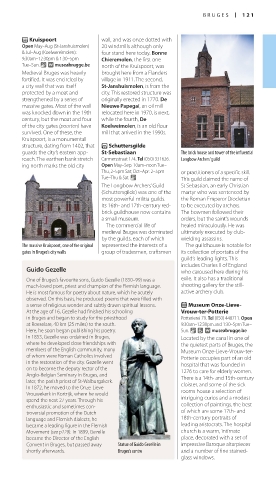
The massive Kruispoort, one of the original represented the interests of a The guildhouse is notable for
gates in Bruges’s city walls group of trades men, crafts men its collec tion of portaits of the
guild’s leading lights. This
includes Charles II of England
Guido Gezelle who caroused here during his
One of Bruges’s favourite sons, Guido Gezelle (1830–99) was a exile. It also has a tradi tional
much-loved poet, priest and champion of the Flemish language. shooting gallery for the still-
He is most famous for poetry about nature, which he acutely active archery club.
observed. On this basis, he produced poems that were filled with
a sense of reli gious wonder and subtly drawn spiritual lessons. E Museum Onze-Lieve-
At the age of 16, Gezelle had finished his schooling Vrouw-ter-Potterie
in Bruges and began to study for the priesthood Potterierei 79. Tel (050) 448711. Open
at Roeselare, 40 km (25 miles) to the south. 9:30am–12:30pm and 1:30–5pm Tue–
Here, he soon began pub lish ing his poetry. Sun. & 7 ∑ museabrugge.be
In 1853, Gezelle was ordained in Bruges, Located by the canal in one of
where he developed close friend ships with the quietest parts of Bruges, the
members of the English community, many Museum Onze-Lieve-Vrouw-ter-
of whom were Roman Catholics involved Potterie occupies part of an old
in the restoration of the city. Gezelle went hospital that was founded in
on to become the deputy rector of the 1276 to care for elderly women.
Anglo-Belgian Seminary in Bruges, and There is a 14th- and 15th-century
later, the parish priest of St-Walburgakerk. cloister, and some of the sick
In 1872, he moved to the Onze-Lieve-
Vrouwekerk in Kortrijk, where he would rooms house a selection of
spend the next 27 years. Through his intriguing curios and a modest
enthusiastic and sometimes con- collec tion of paint ings, the best
troversial promotion of the Dutch of which are some 17th- and
language and Flemish dialects, he 18th-century portraits of
became a leading figure in the Flemish leading aristocrats. The hospital
Movement (see p129). In 1899, Gezelle church is a warm, intimate
became the Director of the English place, decorated with a set of
Convent in Bruges, but passed away Statue of Guido Gezelle in impres sive Baroque altar pieces
shortly afterwards. Bruges’s centre and a number of fine stained-
glass win dows.
120-121_EW_Belgium.indd 121 18/10/16 3:01 pm

