


Page 199 - (DK Eyewitness) Travel Guide - Belgium & Luxembourg
P. 199
bel gium and l uxembourg region b y region 197
central wallonia
Comprising the provinces of namur and brabant
Wallon, Central Wallonia is characterized primarily
by rural landscapes. However, scattered across this
expanse are numerous fine castles and abbeys, and some
of the most impressive caves of the ardennes. The city of
namur, capital of Wallonia, sits at its heart, on the broad
and busy convergence of the rivers meuse and Sambre.
The many fortresses of Central Wallonia’s In parallel with these political and
provinces bear witness to the military military events, religion left its mark on
sig nificance of these lands, which have the land via a number of superb abbeys
been fending off invaders from the and cathedrals, such as the Romanesque
south, east and west for centuries. church in Nivelles. Some buildings, such
For instance, the rock on which the as the 12th-century Abbaye de Villers,
formidable Citadelle of Namur was built are now no more than spectacular ruins,
was once the site of a Roman fortress, while others, such as the 19th-century
and was refortified incessantly over Neo-Gothic Abbaye de Maredsous, are
nearly 2,000 years. The dark castles still active monasteries.
and fortified manor houses are strongly While Charleroi to its west and Liège
evocative of the region’s medieval to its east became centres of heavy
history. In the southwest are garrison industry in the 19th century, Central
towns dating from the 16th century. Wallonia remained largely agricultural.
One of Europe’s most famous battlefields Today, its châteaux and abbeys, the
is in the Province of Brabant Wallon – picturesque River Meuse and the cities
Waterloo, scene of the final defeat of located on its banks are the main draw
Napoleon in 1815. Central Wallonia also for visitors. Towards the south, where
saw much fighting during the World the Belgian landscape rises to form the
Wars, and Dinant marks the furthest Ardennes, limestone caves bristling with
point west reached by the German army stalactites and stalagmites offer an
during the 1944 Ardennes Offensive. equally appealing attraction.
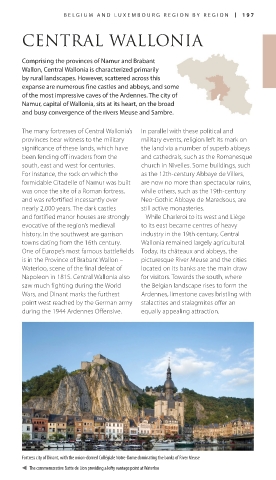
Fortress city of Dinant, with the onion-domed Collégiale Notre-Dame dominating the banks of River Meuse
The commemorative Butte de Lion providing a lofty vantage point at Waterloo
196-197_EW_Belgium.indd 197 16/10/14 3:32 pm

