


Page 202 - (DK Eyewitness) Travel Guide - Belgium & Luxembourg
P. 202
200 BEL GIUM AND L UXEMBOURG REGION B Y REGION
1 Waterloo
The Battle of Waterloo, which took place on 18 June
1815, marked the final defeat of the French emperor
Napoleon Bonaparte. This was immediately
recognized as a pivotal event in European history
and the battlefield became an attraction almost
before the bodies of the dead had been removed.
Memorials and exhibits were set up in the town of
Waterloo as well as at the main scene of the battle,
which lies 3 km (2 miles) to the south. As a result,
some of the exhibits are themselves historic relics.
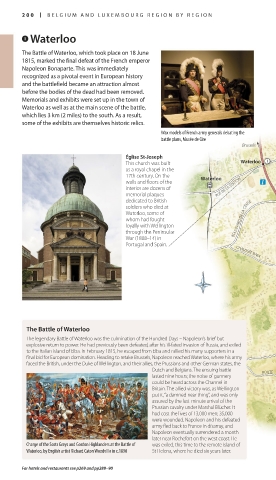
Wax models of French army generals debating the
battle plans, Musée de Cire
Brussels
Église St-Joseph AVE REINE ASTRID
This church was built Waterloo
as a royal chapel in the
17th century. On the Waterloo
walls and floors of the
interior are dozens of RUE DE LA STATION
memorial plaques
dedicated to British
soldiers who died at
Waterloo, some of
whom had fought BOULEVARD DE LA CENSE
loyally with Wellington
through the Peninsular
War (1808–14) in
Portugal and Spain. CHAUSSÉE BARA
The Battle of Waterloo
The legendary Battle of Waterloo was the culmination of the Hundred Days – Napoleon’s brief but
explosive return to power. He had previously been defeated, after his ill-fated invasion of Russia, and exiled
to the Italian island of Elba. In February 1815, he escaped from Elba and rallied his many supporters in a CHAUSSÉE DE
final bid for European domination. Heading to retake Brussels, Napoleon reached Waterloo, where his army MONT ST JEAN
faced the British, under the Duke of Wellington, and their allies, the Prussians and other German states, the
Dutch and Belgians. The ensuing battle
lasted nine hours; the noise of gunnery ROUTE DU LION
could be heard across the Channel in
Britain. The allied victory was, as Wellington
put it, “a damned near thing”, and was only
assured by the last-minute arrival of the
Prussian cavalry under Marshal Blücher. It
had cost the lives of 13,000 men; 35,000
were wounded. Napoleon and his defeated
army fled back to France in disarray, and
Napoleon eventually surrendered a month
later near Rochefort on the west coast. He
Charge of the Scots Greys and Gordon Highlanders at the Battle of was exiled, this time to the remote island of
Waterloo, by English artist Richard Caton Woodville in c.1890 St Helena, where he died six years later.
For hotels and restaurants see p269 and pp289–90
200-201_EW_Belgium.indd 200 18/10/16 3:02 pm
Eyewitness Travel LAYERS PRINTED:
Catalogue template “UK” LAYER
(Source v2.7)
Date 1st October 2013
Size 125mm x 217mm

