


Page 213 - (DK Eyewitness) Travel Guide - Belgium & Luxembourg
P. 213
CENTR AL W ALL ONIA 211
Meuse. Originally a medieval a fortress on this site in the
fortress commanding the river, 12th century, came from the
it was destroyed by the French Beaufort family, and their
in 1554, then rebuilt as a descendants still use the castle
palatial residence in fetching as a residence, giving it the rare
Mosan Renaissance style, with feeling of live-in continuity. The
touches of French château nearby village of Celles is
grandeur, between the 16th considered to be one of
and 18th centuries. This was the prettiest in Wallonia.
the home of the influential
dukes of Beaufort-Spontin. i Basilique
Louis XIV of France stayed here
during his siege of Dinant in St-Materne
1675 and, later that year, signed Rue de la Basilique 12, Walcourt; 18
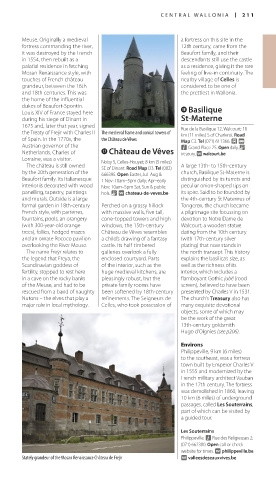
the Treaty of Freÿr with Charles II The medieval frame and conical towers of km (11 miles) S of Charleroi. Road
of Spain. In the 1770s, the the Château de Vêves Map C3. Tel (071) 611366. £ @
Austrian governor of the n Grand Place 25. Open daily. &
Netherlands, Charles of u Château de Vêves treasury. ∑ walcourt.be
Lorraine, was a visitor. Noisy 5, Celles-Houyet; 8 km (5 miles)
The château is still owned SE of Dinant. Road Map D3. Tel (082) A large 13th- to 15th-century
by the 20th generation of the 666395. Open Easter, Jul–Aug & church, Basilique St-Materne is
Beaufort family. Its Italianesque 1 Nov: 10am–5pm daily; Apr–early distinguished by its turrets and
interior is decorated with wood Nov: 10am–5pm Sat, Sun & public peculiar onion-shaped tips on
panelling, tapestry, paintings hols. & ∑ chateau-de-veves.be its spire. Said to be founded by
and murals. Outside is a large the 4th-century St Maternus of
formal garden in 18th-century Perched on a grassy hillock Tongeren, the church became
French style, with parterres, with massive walls, five tall, a pilgrimage site focussing on
fountains, pools, an orangery cone-topped towers and high devotion to Notre Dame de
(with 300-year-old orange windows, the 15th-century Walcourt, a wooden statue
trees), follies, hedged mazes Château de Vêves resembles dating from the 10th century
and an ornate Rococo pavilion a child’s drawing of a fantasy (with 17th-century silver
overlooking the River Meuse. castle. Its half-timbered plating) that now stands in
The name Freÿr relates to galleries overlook a fully the north transept. This history
the legend that Freya, the enclosed courtyard. Parts explains the basilica’s size, as
Scandinavian goddess of of the interior, such as the well as the richness of its
fertility, stopped to rest here huge medieval kitchens, are interior, which includes a
in a cave on the rocky banks pleasingly robust, but the flamboyant Gothic jubé (rood
of the Meuse, and had to be private family rooms have screen), believed to have been
rescued from a band of naughty been softened by 18th-century presented by Charles V in 1531.
Nutons – the elves that play a refinements. The Seigneurs de The church’s Treasury also has
major role in local mythology. Celles, who took possession of many exquisite devotional
objects, some of which may
be the work of the great
13th-century goldsmith
Hugo d’Oignies (see p206).
Environs
Philippeville, 9 km (6 miles)
to the southeast, was a fortress
town built by Emperor Charles V
in 1555 and modernized by the
French military architect Vauban
in the 17th century. The fortress
was demolished in 1860, leaving
10 km (6 miles) of underground
passages, called Les Souterrains,
part of which can be visited by
a guided tour.
Les Souterrains
Philippeville. n Rue des Religieuses 2;
(071) 662300. Open call or check
website for times. ∑ philippeville.be
Stately grandeur of the Mosan Renaissance Château de Freÿr ∑ valleesdeseauxvives.be
210-211_EW_Belgium.indd 211 18/10/16 3:02 pm

