


Page 214 - (DK Eyewitness) Travel Guide - Belgium & Luxembourg
P. 214
212 be L g I u m A nd L uxembourg reg I on b y reg I on
Caves of the Ardennes
Large areas of the Ardennes consist of karst – areas of soft,
porous limestone that, over the centuries, have been gouged
out, tunnelled and dissolved by rivers, streams and rain. In
numerous places, this has created honeycombs of underground
passage ways and galleries, some still filled with lakes and rivers
and containing fantastical arrays of stalactites and stalagmites.
The best of these caves, or grottes, have now become major
attractions. Visitors are led deep into the landscape, sometimes
in boats, to see these extraordinary sculptural formations under
dra matic illumination. There is evidence too, that some of these Grottes de Goyet at Gesves, occupied
caves were shelters for prehistoric people. by Neanderthals 40,000 years ago
Sink holes allow water into
the bed of limestone.
Grotte la Merveilleuse in Dinant is
celebrated for its “frozen waterfalls”:
stalactites and stalagmites with the
glistening limestone seemingly
captured in mid-flow. Guided tours,
lasting about 50 minutes, lead visitors
through successive chambers via
a series of pathways and steps.
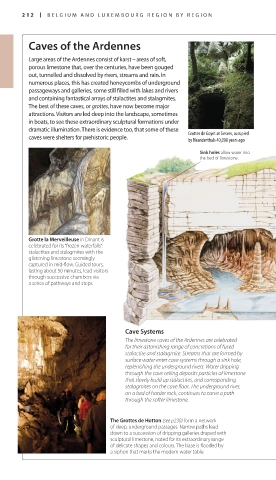
Cave Systems
The limestone caves of the Ardennes are celebrated
for their astonishing range of concretions of fused
stalactite and stalagmite. Streams that are formed by
surface water enter cave systems through a sink hole,
replenishing the underground rivers. Water dripping
through the cave ceiling deposits particles of limestone
that slowly build up stalactites, and corresponding
stalagmites on the cave floor. The underground river,
on a bed of harder rock, continues to carve a path
through the softer limestone.
The Grottes de Hotton (see p230) form a network
of deep, underground passages. Narrow paths lead
down to a succession of dripping galleries draped with
sculptural limestone, noted for its extraordinary range
of delicate shapes and colours. The base is flooded by
a siphon that marks the modern water table.
212-213_EW_Belgium.indd 212 16/10/14 3:31 pm

