


Page 226 - (DK Eyewitness) Travel Guide - Belgium & Luxembourg
P. 226
224 BEL GIUM AND L UXEMBOURG REGION B Y REGION
church is best known for its
15th-century rose window, Li
Rondia. This is cited as one of the
four wonders of Hutois heritage,
the others being Li Tchestia (The
Fort), Li Bassinia (the 15th-century
fountain in the Grand Place) and
Li Pontia (a bridge over the Meuse).
P Fort de Huy
Chaussée Napoléon. Tel (085) 215334.
Open Easter–Sep. &
4 Château de
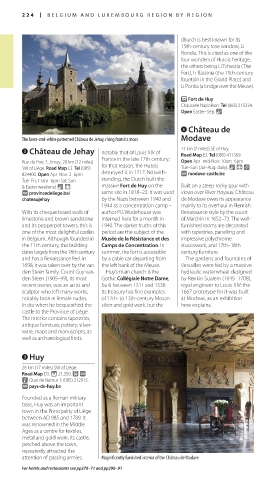
The fawn-and-white patterned Château de Jehay, rising from its moat Modave
11 km (7 miles) SE of Huy.
2 Château de Jehay notably that of Louis XIV of Road Map E3. Tel (085) 411369.
France in the late 17th century;
Rue du Parc 1, Amay; 20 km (12 miles) Open Apr–mid-Nov: 10am–6pm
SW of Liège. Road Map E3. Tel (085) for that reason, the Hutois Tue–Sun (Jul–Aug: daily). & 9 0
824400. Open Apr–Nov: 2–6pm destroyed it in 1717. Notwith- ∑ modave-castle.be
Tue–Fri, 11am–6pm Sat, Sun standing, the Dutch built the
& Easter weekend. & 9 massive Fort de Huy on the Built on a steep rocky spur with
∑ provincedeliege.be/ same site in 1818–23. It was used views over River Hoyaux, Château
chateaujehay by the Nazis between 1940 and de Modave owes its appear ance
1944 as a concentration camp – mainly to its over haul in Flemish
With its chequerboard walls of author PG Wodehouse was Renaissance style by the count
limestone and brown sandstone interned here for a month in of Marchin in 1652–73. The well-
and its pepperpot towers, this is 1940. The darker truths of this furnished rooms are decorated
one of the most delightful castles period are the subject of the with tapestries, panelling and
in Belgium. Although founded in Musée de la Résistance et des impressive polychrome
the 11th century, the building Camps de Concentration. In stuccowork, and 17th–18th
dates largely from the 16th century summer, the fort is accessible century furniture.
and has a Renaissance feel. In by a cable car departing from The gardens and fountains of
1698, it was taken over by the van the left bank of the Meuse. Versailles were fed by a massive
den Steen family. Count Guy van Huy’s main church is the hydraulic waterwheel designed
den Steen (1905–99), its most Gothic Collégiale Notre Dame, by Renkin Sualem (1645–1708),
recent owner, was an artist and built between 1311 and 1536. royal engineer to Louis XIV: the
sculptor who left many works, Its treasury has fine examples 1667 proto type for it was built
notably bronze female nudes, of 12th- to 13th-century Mosan at Modave, as an exhibition
in situ when he bequeathed the silver and gold work, but the here explains.
castle to the Province of Liège.
The interior contains tapestries,
antique furniture, pottery, silver-
ware, maps and manuscripts, as
well as archaeological finds.
3 Huy
28 km (17 miles) SW of Liège.
Road Map D3. * 21,350. £ @
n Quai de Namur 1; (085) 212915.
∑ pays-de-huy.be
Founded as a Roman military
base, Huy was an important
town in the Principality of Liège
between AD 985 and 1789. It
was renowned in the Middle
Ages as a centre for textiles,
metal and gold work. Its castle,
perched above the town,
repeatedly attracted the
attention of pas sing armies, Magnificently furnished interior of the Château de Modave
For hotels and restaurants see pp270–71 and pp290–91
224-225_EW_Belgium.indd 224 18/10/16 3:02 pm
Eyewitness Travel LAYERS PRINTED:
Catalogue template “UK” LAYER
(Source v2.7)
Date 1st October 2013
Size 125mm x 217mm

