


Page 23 - (DK Eyewitness) Travel Guide - Belgium & Luxembourg
P. 23
A POR TR AIT OF BEL GIUM AND L UXEMBOURG 21
a language of the German family. Many
of its people are genuinely trilingual, and
switch easily between the three languages.
Belgium is divided into two main
linguistic regions. In the north is Flanders,
with 59 per cent of the population. The
people, known as the Flemish, speak Dutch.
In the south is Wallonia, which holds 31 per
cent of the population; people here speak
French. Apart from these, there is a small
German-speaking community in the border
region of the east.
The Dutch-French language divide
has existed more or less since Roman
and Frankish times, in other words for
1,500 years. In spite of their differences,
the Flemish and French-speaking
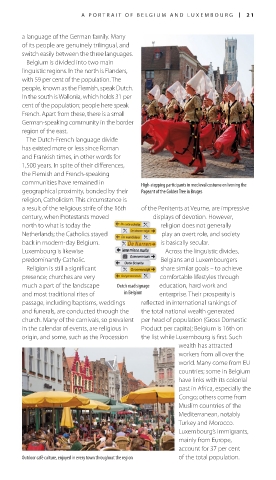
communities have remained in High-stepping participants in medieval costume enlivening the
geographical proximity, bonded by their Pageant of the Golden Tree in Bruges
religion, Catholicism. This circumstance is
a result of the religious strife of the 16th of the Penitents at Veurne, are impressive
century, when Protestants moved displays of devotion. However,
north to what is today the religion does not generally
Netherlands; the Catholics stayed play an overt role, and society
back in modern-day Belgium. is basically secular.
Luxembourg is likewise Across the linguistic divides,
predominantly Catholic. Belgians and Luxembourgers
Religion is still a significant share similar goals – to achieve
presence; churches are very comfortable lifestyles through
much a part of the landscape Dutch road signage education, hard work and
and most traditional rites of in Belgium enterprise. Their prosperity is
passage, including baptisms, weddings reflected in international rankings of
and funerals, are conducted through the the total national wealth generated
church. Many of the carnivals, so prevalent per head of population (Gross Domestic
in the calendar of events, are religious in Product per capita); Belgium is 16th on
origin, and some, such as the Procession the list while Luxembourg is first. Such
wealth has attracted
workers from all over the
world. Many come from EU
countries; some in Belgium
have links with its colonial
past in Africa, especially the
Congo; others come from
Muslim countries of the
Mediterranean, notably
Turkey and Morocco.
Luxembourg’s immigrants,
mainly from Europe,
account for 37 per cent
Outdoor café culture, enjoyed in every town throughout the region of the total population.
020-021_EW_Belgium.indd 21 18/10/16 2:56 pm

