


Page 27 - (DK Eyewitness) Travel Guide - Belgium & Luxembourg
P. 27
a por tr ait of bel gium and l uxembourg 25
Depleting Wildlife
It is estimated that between a third and a half of Belgium’s
animal species are threatened with extinction. Twelve
mammals are listed as either Endangered, Vulnerable or
Near Threatened by the International Union for
Conservation of Nature and Natural Resources (IUCN). As
ever, the main causes of threat are loss of habitat, climate
change, the arrival of exotic predators and pollution or
other human activities that cause disturbance. The red
squirrel and European otter (Lutra lutra) are on the Near
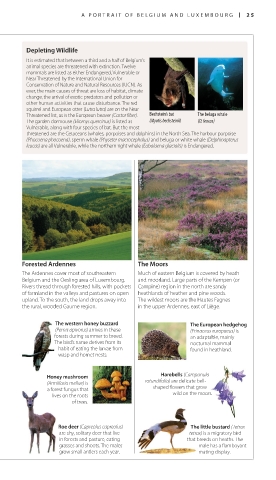
Threatened list, as is the European beaver (Castor fiber). Bechstein’s bat The beluga whale
The garden dormouse (Eliomys quercinus) is listed as (Myotis bechsteinii) (D. leucas)
Vulnerable, along with four species of bat. But the most
threatened are the Cetaceans (whales, porpoises and dolphins) in the North Sea. The harbour porpoise
(Phocoena phocoena), sperm whale (Physeter macrocephalus) and beluga or white whale (Delphinapterus
leucas) are all Vulnerable, while the northern right whale (Eubalaena glacialis) is Endangered.
Forested Ardennes The Moors
The Ardennes cover most of southeastern Much of eastern Belgium is covered by heath
Belgium and the Oesling area of Luxembourg. and moorland. Large parts of the Kempen (or
Rivers thread through forested hills, with pockets Campine) region in the north are sandy
of farmland in the valleys and pastures on open heathlands of heather and pine woods.
upland. To the south, the land drops away into The wildest moors are the Hautes Fagnes
the rural, wooded Gaume region. in the upper Ardennes, east of Liège.
The western honey buzzard The European hedgehog
(Pernis apivorus) arrives in these (Erinaceus europaeus) is
forests during summer to breed. an adaptable, mainly
The bird’s name derives from its nocturnal mammal
habit of eating the larvae from found in heathland.
wasp and hornet nests.
Honey mushroom Harebells (Campanula
(Armillaria mellae) is rotundifolia) are delicate bell-
a forest fungus that shaped flowers that grow
lives on the roots wild on the moors.
of trees.
Roe deer (Capreolus capreolus) The little bustard (Tetrax
are shy, solitary deer that live tetrax) is a migratory bird
in forests and pasture, eating that breeds on heaths. The
grasses and shoots. The males male has a flamboyant
grow small antlers each year. mating display.
024-025_EW_Belgium.indd 25 16/10/14 3:33 pm

