


Page 28 - (DK Eyewitness) Travel Guide - Belgium & Luxembourg
P. 28
26 introducing bel gium and l uxembourg
Belgian Artists last Flemish Primitive.
Moving into the 16th
belgian art rose to the fore when the region came under century, landscape artist
burgundian rule in the 15th century. renaissance painters Joachim Patinir (c.1480–
produced strong works in oil, characterized by intricate 1524) produced the first
European industrial scenes.
detail and lifelike, unidealized portraiture. trade and artistic
links with italy provided a rich, mutual exchange of painting
techniques in the per ennial quest to capture visual reality. in The Brueghel Dynasty
contrast, during the 20th century, belgium’s second golden In the early years of the
artistic age moved away from these goals, abandoning reality 16th century, Belgian art
for Surrealism in the work of artists such as rené magritte. was strongly influenced by
the Italians. Trained in Rome,
brussels’s musées royaux des beaux-arts (see pp72–7), the Jan Gossaert (c.1478–1532)
rubenshuis (see pp154–5) in antwerp and the museums brought mythological themes
around St-martens-latem (see p140) are fine examples of the to the art commissioned by
respect belgium shows to its artists’ works, homes and contexts. the ruling dukes of Brabant.
However, it was the prolific
Brueghel family who
responsible, with his brother, for exercised the most influence
the striking polyp tych altarpiece on Flemish art throughout
Adoration of the Mystic Lamb, dis- the 16th and 17th centuries.
played in St-Baafskathedraal (see Pieter Brueghel the Elder
p136) in Ghent. (c.1525–69), one of the
The trademarks of the greatest Flemish artists,
Flemish Primitives are a lifelike settled in Brussels in 1563.
vitality, enhanced by realism in His earthy rustic landscapes
portraiture, texture of clothes of village life, peopled with
and furnishings and a clarity comic peasants, are a social
of light. A highly expressive study of medieval life and
interpreter of the style was the remain his best-known work.
town painter of Brussels, Rogier Pieter Brueghel the Younger
van der Weyden (c.1400–64), (1564–1636) produced
known in French as Rogier de religious works such as The
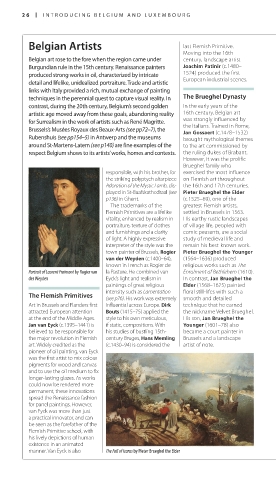
Portrait of Laurent Froimont by Rogier van la Pasture. He combined van Enrolment of Bethlehem (1610).
der Weyden Eyck’s light and realism in In contrast, Jan Brueghel the
paintings of great religious Elder (1568–1625) painted
intensity such as Lamentation floral still-lifes with such a
The Flemish Primitives
(see p76). His work was extremely smooth and detailed
Art in Brussels and Flanders first influential across Europe. Dirk technique that he earned
attracted European attention Bouts (1415–75) applied the the nickname Velvet Brueghel.
at the end of the Middle Ages. style to his own meticulous, His son, Jan Brueghel the
Jan van Eyck (c.1395–1441) is if static, compositions. With Younger (1601–78) also
believed to be responsible for his studies of bustling 15th- became a court painter in
the major revolution in Flemish century Bruges, Hans Memling Brussels and a landscape
art. Widely credited as the (c.1430–94) is considered the artist of note.
pioneer of oil painting, van Eyck
was the first artist to mix colour
pigments for wood and canvas
and to use the oil medium to fix
longer-lasting glazes. As works
could now be rendered more
permanent, these innovations
spread the Renaissance fashion
for panel paintings. However,
van Eyck was more than just
a practical innovator, and can
be seen as the forefather of the
Flemish Primitive school, with
his lively depictions of human
existence in an animated
manner. Van Eyck is also The Fall of Icarus by Pieter Brueghel the Elder
026-027_EW_Belgium.indd 26 16/10/14 3:35 pm
Eyewitness Travel LAYERS PRINTED:
Feature template “UK” LAYER
(SourceReport v1.3)
Date 18th October 2012
Size 125mm x 217mm

