


Page 67 - (DK Eyewitness) Travel Guide - Belgium & Luxembourg
P. 67
Brussels 65
shaped turrets and ornamental
The Béguine Movement
walls. The unusually wide aisles
The béguine lifestyle swept across western Europe during the give it a light, airy feeling inside.
13th century. The order is believed to have begun among widows of The nave, which is also Baroque,
the Crusaders who resorted to a pious life of sisterhood on the death is decorated with ornate
of their husbands. Single women opted for a secluded existence cherubs, angels and scrolls, while
devoted to charitable deeds, but not bound by strict religious vows. the confes sionals are carved with
They were free to leave at any allegorical figures and saints. The
time, for instance to marry. apse contains a striking statue of
Many béguine convents St John the Baptist, and the 1757
disap peared during the pulpit, a fine example of Baroque
Protestant Reformation, but woodcarving, depicts St Dominic
begijnhofs (béguinages) trampling a heretic underfoot.
continued to thrive in
Flanders. These areas generally
consisted of a church, a 0 Théâtre
courtyard, communal rooms Marionnettes
and homes for the women.
Brussels once had a de Toone
community of over 1,200 Impasse Ste-Pétronille, 66 Rue du
béguines, but the movement Marché-aux-Herbes, 1000 BRU.
dissolved as female City Map 2 D2. Tel (02) 5117137.
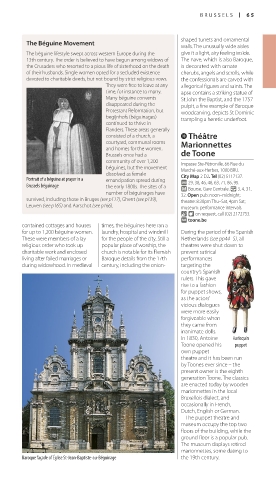
Portrait of a béguine at prayer in a emancipation spread during @ 29, 38, 46, 48, 63, 71, 86, 95.
Brussels béguinage the early 1800s. The sites of a q Bourse, Gare Centrale. v 3, 4, 31,
number of béguinages have 32. Open pub: noon–midnight;
survived, including those in Bruges (see p117), Ghent (see p139), theatre: 8:30pm Thu–Sat, 4pm Sat;
Leuven (see p165) and Aarschot (see p166). museum: performance intervals.
& 8 on request, call (02) 2172753.
∑ toone.be
contained cottages and houses times, the béguines here ran a
for up to 1,200 béguine women. laundry, hospital and windmill During the period of the Spanish
These were members of a lay for the people of the city. Still a Netherlands (see pp44–5), all
religious order who took up popu lar place of worship, the theatres were shut down to
charitable work and enclosed church is notable for its Flemish prevent satirical
living after failed marriages or Baroque details from the 17th performances
during widowhood. In medieval century, including the onion- targeting the
country’s Spanish
rulers. This gave
rise to a fashion
for puppet shows,
as the actors’
vicious dialogues
were more easily
forgiveable when
they came from
inanimate dolls.
In 1830, Antoine Harlequin
Toone opened his puppet
own puppet
theatre and it has been run
by Toones ever since – the
present owner is the eighth
generation Toone. The classics
are enacted today by wooden
marionn ettes in the local
Bruxellois dialect, and
occasionally in French,
Dutch, English or German.
The puppet theatre and
museum occupy the top two
floors of the building, while the
ground floor is a popular pub.
The museum displays retired
marionnettes, some dating to
Baroque façade of Église St-Jean-Baptiste-au-Béguinage the 19th century.
064-065_EW_Belgium.indd 65 16/10/14 3:33 pm

