


Page 62 - (DK Eyewitness) Travel Guide - Belgium & Luxembourg
P. 62
60 BEL GIUM AND L UXEMBOURG REGION B Y REGION
The Grand Place
The geographical, historical and commercial heart of the
city, the Grand Place is the first port of call for most visitors
to Brussels. The square remains the civic centre centuries after
its creation, and offers the finest example of Belgium’s ornate
17th-century architecture in one area. Open-air markets took
place around this site as early as the 11th century, although
Brussels’s town hall, the Hôtel de Ville, was built only by the
end of the 15th century. City traders further added guild-
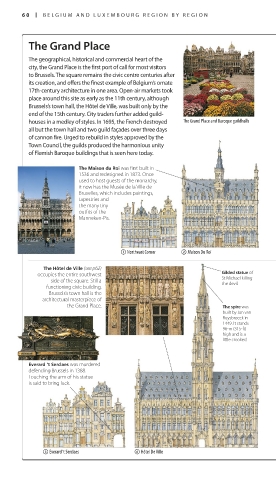
houses in a medley of styles. In 1695, the French destroyed The Grand Place and Baroque guildhalls
all but the town hall and two guild façades over three days
of cannon fire. Urged to rebuild in styles approved by the
Town Council, the guilds produced the harmonious unity
of Flemish Baroque buildings that is seen here today.
The Maison du Roi was first built in
1536 and redesigned in 1873. Once
used to host guests of the monarchy,
it now has the Musée de la Ville de
Bruxelles, which includes paint ings,
tapestries and
the many tiny
outfits of the
Manneken-Pis.
1 Northeast Corner 2 Maison Du Roi
The Hôtel de Ville (see p62)
occupies the entire southwest Gilded statue of
St Michael killing
side of the square. Still a the devil.
functioning civic building,
Brussels’s town hall is the
architectural masterpiece of
the Grand Place. The spire was
built by Jan van
Ruysbroeck in
1449. It stands
96-m (315-ft)
high and is a
little crooked.
Everard ‘t Serclaes was murdered
defending Brussels in 1388.
Touching the arm of his statue
is said to bring luck.
5 Everard ‘t Serclaes 6 Hôtel De Ville
060-061_EW_Belgium.indd 60 18/10/16 3:00 pm
Eyewitness Travel LAYERS PRINTED:
Feature template “UK” LAYER
(SourceReport v1.3)
Date 18th October 2012
Size 125mm x 217mm

