


Page 65 - (DK Eyewitness) Travel Guide - Belgium & Luxembourg
P. 65
BRUSSELS 63
5 La Bourse
Luxurious Lace
Palais de la Bourse, 1000 BRU.
Lace (dentelle in French, kant in Dutch) has always been a luxury City Map 1 C2. Tel (02) 5091373.
product, as it is a hugely labour-intensive accessory. Belgian lace @ 46, 48, 86, 95. q Bourse. v 3, 4,
has had a high reputation since the bobbin lace technique was 31, 32. Closed No longer open to the
introduced from Italy in the 17th century. Patterns are created by public. Bruxella 1238: (02) 2794355.
manipulating dozens of threads, each attached to a wooden Open 1st Wed of month; can be
bobbin, around pins embedded in a cushion. Lace has been used visited by appoint ment at other times.
for clothes, shawls and church vestments, as well as table and bed & 8 obligatory, 10:15am (English),
linen. Historically, it was made by women of all social classes – by 11:15am (French), 2pm (Dutch).
the nobility as a pastime, by
nuns and béguines in Brussels’s Stock Exchange,
convents, and by ill-paid La Bourse, is one of the city’s
cottage workers exploited
by unscrupulous middle- most impressive buildings,
and it dominates the square
men. During the 19th-
century love-affair with of the same name. Designed
lace, there were perhaps in Palladian style by architect
50,000 lace-makers in Léon Suys, the building was
Belgium. Despite constructed between 1867 and
competition from machine- 1873. Among its most notable
made lace, handmade features are the ornate carv-
Belgian lace is still ings on each façade. The great
produced and carries a French sculptor, Auguste Rodin
certificate of provenance. A display of delicately patterned lace (1840 – 1917), is rumoured to
have crafted four caryatids
inside, as well as the statues
donated by a visiting dignitary bell tower finally collapsed. repre senting Africa and Asia in
since the tradition began some Several res toration pro jects allegorical groups on the roof.
three centuries ago. were plan ned but none came Beneath the col onnade are
to fruition until 1956, when two beautifully detailed
the west side of the build ing winged figures representing
4 Église St-Nicolas was given a new Gothic- good and evil which were
style façade. carved by Flemish sculptor
Rue au Beurre 1, 1000 BRU.
City Map 2 D2. Tel (02) 5138022. Dedicated to St Nicolas, Jacques de Haen (1831–
@ 29, 38, 46, 47, 63, 65, 66, 71, 86, 88, the patron saint of 1900). Once the scene
95. q Bourse, De Brouckère. v 3, 4, mer chants, this low-lit of frantic trading, La
31, 32. Open 8am–6:30pm Mon–Fri, atmos pheric church Bourse today houses
9am–6pm Sat, 9am–7:30pm Sun & is known for its choir the offices of Euronext,
public holidays. Closed during services. stalls, dating the owners of
from 1381, the Belgian
A market church was built on which depict Stock Exchange,
this site at the end of the 12th the story of Allegorical statues crowning the roof line and all financial
century, but, like much of the St Nicolas on of La Bourse activity is now
Lower Town, it was damaged in medal lions. via computers.
the 1695 French bombard ment. The unusual angle of the chapel On its northern side are some
A cannon ball lodged itself into is reportedly to avoid the flow archaeo logical remains from
an interior pillar and in 1714, the of an old stream. medieval Brussels, exhibited
at Bruxella 1238. Discovered
unexpect edly during roadworks
in 1998, these include the remains
of a 13th-century Franciscan
convent, a church and the grave
of Duke John I of Brabant who
was buried here in 1294.
A small museum has been
built on the site, where interested
visitors can see the relics of social
and religious life in 13th-century
Brussels on display. To protect
the remains from degradation,
the area is accessible only by
guided tours, starting from the
Musée de la Ville de Bruxelles
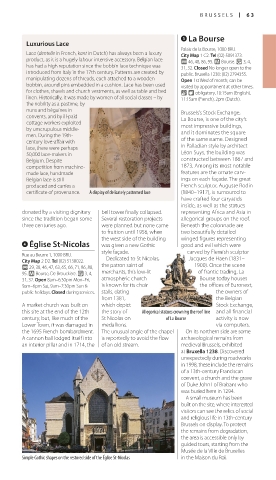
Simple Gothic shapes on the restored side of the Église St-Nicolas in the Maison du Roi.
062-063_EW_Belgium.indd 63 18/10/16 3:01 pm

