


Page 128 - (DK Eyewitness) Travel Guide - Krakow
P. 128
126 KR AK OW AREA B Y AREA
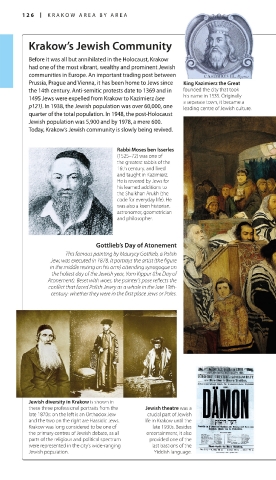
Krakow’s Jewish Community
Before it was all but annihilated in the Holocaust, Krakow
had one of the most vibrant, wealthy and prominent Jewish
communities in Europe. An important trading post between
Prussia, Prague and Vienna, it has been home to Jews since King Kazimierz the Great
the 14th century. Anti-semitic protests date to 1369 and in founded the city that took
1495 Jews were expelled from Krakow to Kazimierz (see his name in 1335. Originally
a separate town, it became a
p121). In 1938, the Jewish population was over 60,000, one leading centre of Jewish culture.
quarter of the total population. In 1948, the post-Holocaust
Jewish population was 5,900 and by 1978, a mere 600.
Today, Krakow’s Jewish community is slowly being revived.
Rabbi Moses ben Isserles
(1525–72) was one of
the greatest rabbis of the
16th century, and lived
and taught in Kazimierz.
He is revered by Jews for
his learned additions to
the Shulkhan Arukh (the
code for everyday life). He
was also a keen historian,
astronomer, geometrician
and philosopher.
Gottlieb’s Day of Atonement
This famous painting by Maurycy Gottlieb, a Polish
Jew, was executed in 1878. It portrays the artist (the figure
in the middle resting on his arm) attending synagogue on
the holiest day of the Jewish year, Yom Kippur (the Day of
Atonement). Beset with woes, the painter’s pose reflects the
conflict that faced Polish Jewry as a whole in the late 19th-
century: whether they were in the first place Jews or Poles.
Jewish diversity in Krakow is shown in
these three professional portraits from the Jewish theatre was a
late 1870s: on the left is an Orthodox Jew crucial part of Jewish
and the two on the right are Hassidic Jews. life in Krakow until the
Krakow was long considered to be one of late 1930s. Besides
the primary centres of Jewish debate, as all entertainment, it also
parts of the religious and political spectrum provided one of the
were represented in the city’s wide-ranging last bastions of the
Jewish population. Yiddish language.

