


Page 129 - (DK Eyewitness) Travel Guide - Krakow
P. 129
K AZIMIERZ QU AR TER 127
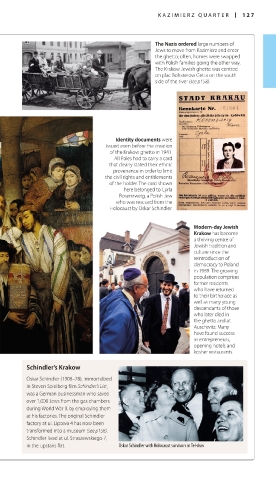
The Nazis ordered large numbers of
Jews to move from Kazimierz and enter
the ghetto; often, homes were swapped
with Polish families going the other way.
The Krakow Jewish ghetto was centred
on plac Bohaterow Getta on the south
side of the river (see p158).
Identity documents were
issued even before the creation
of the Krakow ghetto in 1941.
All Poles had to carry a card
that clearly stated their ethnic
provenance in order to limit
the civil rights and entitlements
of the holder. The card shown
here belonged to Cyrla
Rosenzweig, a Polish Jew
who was rescued from the
Holocaust by Oskar Schindler.
Modern-day Jewish
Krakow has become
a thriving centre of
Jewish tradition and
culture since the
reintroduction of
democracy to Poland
in 1989. The growing
population comprises
former residents
who have returned
to their birthplace as
well as many young
descendants of those
who later died in
the ghetto and at
Auschwitz. Many
have found success
as entrepreneurs,
opening hotels and
kosher restaurants.
Schindler’s Krakow
Oskar Schindler (1908–78), immortalized
in Steven Spielberg film Schindler’s List,
was a German businessman who saved
over 1,000 Jews from the gas chambers
during World War II, by employing them
at his factories. The original Schindler
factory at ul. Lipowa 4 has now been
transformed into a museum (see p158).
Schindler lived at ul. Straszewskiego 7,
in the upstairs flat. Oskar Schindler with Holocaust survivors in Tel-Aviv

