


Page 168 - (DK Eyewitness) Travel Guide - Krakow
P. 168
166 FUR THER AFIELD
Auschwitz II–Birkenau
Birkenau was primarily a place of execution. Most of
Auschwitz’s machinery of murder was housed here. In the
six gas chambers in use at different stages of the camp’s
construction, over one million people were killed, 98% of
whom were Jewish. Victims included people from over
20 nations. Birkenau was also an enormous concentration
camp, housing 90,000 slave labourers by mid-1944 and Hell’s Gate
providing labour for many of the factories and farms of In 1944 the numbers arriving
southwestern, Nazi-occupied Poland. The gas chambers began to increase dramatically.
were quickly destroyed by the Nazis shortly before the A rail line was extended into the
camp. The entrance gate through
Soviet Army arrived in January 1945. which the trains passed was
known as “Hell’s Gate”.
Visiting Birkenau
There is little left of the
camp’s buildings today;
its main purpose is for
remembrance. Most visitors
come to pay their respects at
the Monument to the Victims
of the Camp, near the site of
the gas chambers.
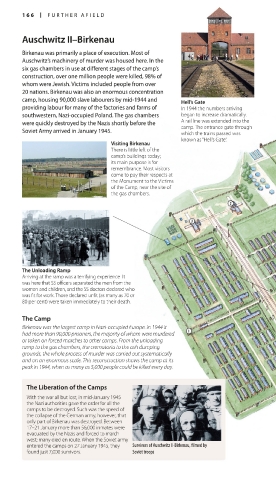
The Unloading Ramp
Arriving at the ramp was a terrifying experience It
was here that SS officers separated the men from the
women and children, and the SS doctors declared who
was fit for work. Those declared unfit (as many as 70 or
80 per cent) were taken immediately to their death.
The Camp
Birkenau was the largest camp in Nazi-occupied Europe. In 1944 it
had more than 90,000 prisoners, the majority of whom were murdered
or taken on forced marches to other camps. From the unloading
ramp to the gas chambers, the crematoria to the ash dumping
grounds, the whole process of murder was carried out systematically
and on an enormous scale. This reconstruction shows the camp at its
peak in 1944, when as many as 5,000 people could be killed every day.
The Liberation of the Camps
With the war all but lost, in mid-January 1945
the Nazi authorities gave the order for all the
camps to be destroyed. Such was the speed of
the collapse of the German army, however, that
only part of Birkenau was destroyed. Between
17–21 January more than 56,000 inmates were
evacuated by the Nazis and forced to march
west; many died en route. When the Soviet army
entered the camps on 27 January 1945, they Survivors of Auschwitz II-Birkenau, filmed by
found just 7,000 survivors. Soviet troops

