


Page 175 - (DK Eyewitness) Travel Guide - Krakow
P. 175
THREE GUIDED W ALKS 173
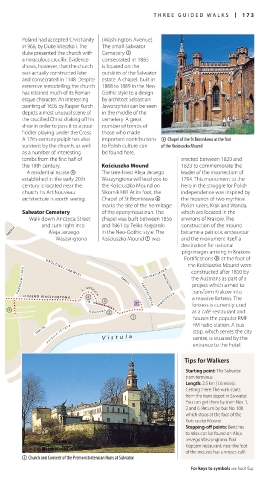
Poland had accepted Christianity (Washington Avenue).
in 966, by Duke Mieszko I. The The small Salwator
duke presented the church with Cemetery 5
a miraculous crucifix. Evidence consecrated in 1865
shows, however, that the church is located on the
was actually constructed later outskirts of the Salwator
and consecrated in 1148. Despite estate. A chapel, built in
extensive remodelling, the church 1888 to 1889 in the Neo-
has retained much of its Roman- Gothic style to a design
esque character. An interesting by architect Sebastian
painting of 1605 by Kasper Kurch Jaworzyński can be seen
depicts a most unusual scene of in the middle of the
the crucified Christ shaking off his cemetery. A great
shoe in order to pass it to a poor number of tombs of
fiddler playing under the Cross. those who made
A 17th-century pulpit has also important contributions 6 Chapel of the St Bronisława at the foot
survived by the church, as well to Polish culture can of the Kościuszko Mound
as a number of interesting be found here.
tombs from the first half of erected between 1820 and
the 19th century. Kościuszko Mound 1823 to commemorate the
A residential estate 4 The tree-lined Aleja Jerzego leader of the insurrection of
established in the early 20th Waszyngtona will lead you to 1794. This monument to the
century is located near the the Kościuszko Mound on hero in the struggle for Polish
church. Its Art Nouveau Sikornik Hill. At its foot, the independence was inspired by
architecture is worth seeing. Chapel of St Bronisława 6 the mounds of two mythical
marks the site of the hermitage Polish rulers, Krak and Wanda,
Salwator Cemetery of the eponymous nun. The which are located in the
Walk down Anczyca Street chapel was built between 1856 environs of Krakow. The
and turn right into and 1861 by Feliks Księżarski construction of the mound
PRZEGON Aleja Jerzego in the Neo-Gothic style. The became a patriotic endeavour
Waszyngtona Kościuszko Mound 7 was and the monument itself a
destination for national
pilgrimages arriving in Krakow.
Fortifications 8 at the foot of
the Kościuszko Mound were
P A N OR AM I C Z N A EMAUS S A L W A T O R S K A MLASKOTÓW the Austrians as part of a
constructed after 1850 by
K RÓLO W E J J ADW I G I
project which aimed to
4
a massive fortress. The
J E R Z E G O W A S Z YN G T ON A L . ANCZYCA KA S Z T E LAŃ S K A transform Krakow into
3 S E N ATO R S KA fortress is currently used
5 G O N T Y N A 2 as a café-restaurant and
Ś W. B RO N I S Ł A WY
1 houses the popular RMF
K S I Ę C I A J Ó Z E F A V i s t u l a centre, is situated by the
UKRYTA FM radio station. A bus
stop, which serves the city
entrance to the hotel.
Tips for Walkers
Starting point: The Salwator
tram terminus.
Length: 2.5 km (1.6 miles).
Getting there: The walk starts
from the tram depot in Salwator.
You can get there by tram Nos. 1,
2 and 6. Return by bus No. 100
which stops at the foot of the
Kościuszko Mound.
Stopping-off points: Benches
to relax can be found on Aleja
Jerzego Waszyngtona. Pod
Kopcem restaurant, near the foot
of the mound, has a terrace café.
1 Church and Convent of the Premonstratensian Nuns at Salwator
For keys to symbols see back flap

