


Page 67 - (DK Eyewitness) Travel Guide - Krakow
P. 67
W A WEL HILL 65
by the administration office),
will appeal to those interested
in the medieval history of
Wawel. There were possibly
ten churches on Wawel Hill
in the past. The Rotunda of
the Virgin Mary (Sts Felix
and Adauctus), unearthed
in 1917 during excavations
carried out by Adolf Szyszko-
Bohusz, is of great interest.
The excavations also brought
to light the remnants of a
man’s body as well as some
articles of jewellery nearby.
It is believed that the circular
rotunda formed part of the
first palatium (the seat of
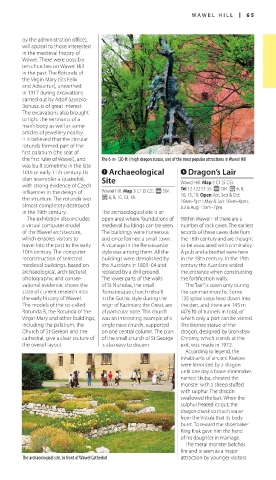
the first ruler of Wawel), and The 6-m- (20-ft-) high dragon statue, one of the most popular attractions in Wawel Hill
was built sometime in the late
10th or early 11th century. Its 7Archaeological 8Dragon’s Lair
plan resembles a quatrefoil, Site Wawel Hill. Map 3 C1 (5 C5).
with strong evidence of Czech Tel 12 422 51 55. @ 504. v 6, 8,
influences in the design of Wawel Hill. Map 3 C1 (5 C5). @ 504. 10, 13, 18. Open Apr, Sep & Oct:
the structure. The rotunda was v 6, 8, 10, 13, 18. 10am–5pm; May & Jun: 10am–6pm;
almost completety destroyed Jul & Aug: 10am–7pm.
in the 19th century. The archaeological site is an
The exhibition also includes open area where foundations of Within Wawel Hill there are a
a virtual computer model medieval buildings can be seen. number of rock caves. The earliest
of the Wawel architecture, The buildings were numerous records of these caves date from
which enables visitors to and once formed a small town. the 16th century and are thought
travel into the past to the early A vicarage in the Renaissance to be associated with criminality.
10th century. The computer style was among them. All the A pub and a brothel were here
reconstruction of selected buildings were demolished by in the 18th century. In the 19th
medieval buildings, based on the Austrians in 1803–04 and century the Austrians sealed
archaeological, architectural, replaced by a drill ground. the entrance when constructing
photographic and conser- The lower parts of the walls the fortification walls.
vational evidence, shows the of St Nicholas, the small The “lair” is open only during
state of current research into Romanesque church rebuilt the summer months. Some
the early history of Wawel. in the Gothic style during the 135 spiral steps lead down into
The models of the so-called reign of Kazimierz the Great, are the den, and there are 145 m
Rotunda B, the Rotunda of the of particular note. This church (476 ft) of tunnels in total, of
Virgin Mary and other buildings, was an interesting example of a which only a part can be visited.
including the palatium, the single nave church, supported The bronze statue of the
Church of St Gereon and the on one central column. The plan dragon, designed by Bronisław
cathedral, give a clear picture of of the small church of St George Chromy, which stands at the
the overall layout. is also easy to discern. exit, was made in 1972.
According to legend, the
inhabitants of ancient Krakow
were terrorized by a dragon
until one day a brave shoemaker,
named Skuba, cheated the
monster with a sheep stuffed
with sulphur. The dragon
swallowed the bait. When the
sulphur heated its gut, the
dragon drank so much water
from the Vistula that its body
burst. To reward the shoemaker
King Krak gave him the hand
of his daughter in marriage.
The metal monster belches
fire and is seen as a major
The archaeological site, in front of Wawel Cathedral attraction by younger visitors.

