


Page 73 - (DK Eyewitness) Travel Guide - Krakow
P. 73
W A WEL C A THEDR AL 71
His body was never found,
giving rise to stories about
his miraculous salvation.
Royal Tombs
The Royal Tombs were placed
in the crypt following the
construction of the Zygmunt
Chapel, which is a mausoleum.
Zygmunt the Old and his sons
are buried in the crypt under
the chapel. Earlier rulers were
buried in the cathedral, except
Bolesław the Brave, Bolesław
the Bold, Przemysław II, Louis
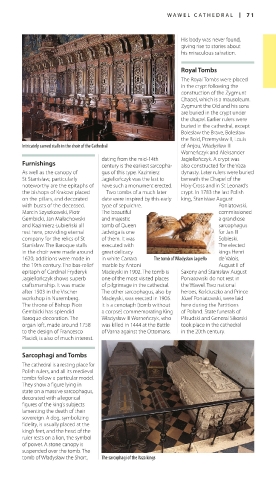
Intricately carved stalls in the choir of the Cathedral of Anjou, Władysław III
Warneńczyk and Aleksander
dating from the mid-14th Jagiellończyk. A crypt was
Furnishings century is the earliest sarcopha- also constructed for the Vaza
As well as the canopy of gus of this type. Kazimierz dynasty. Later rulers were buried
St Stanisław, particularly Jagiellończyk was the last to beneath the Chapel of the
noteworthy are the epitaphs of have such a monument erected. Holy Cross and in St Leonard’s
the bishops of Krakow placed Two tombs of a much later crypt. In 1783 the last Polish
on the pillars, and decorated date were inspired by this early king, Stanisław August
with busts of the deceased. type of sepulchre. Poniatowski,
Marcin Szyszkowski, Piotr The beautiful commissioned
Gembicki, Jan Małachowski and majestic a grandiose
and Kazimierz Łubieński all tomb of Queen sarcophagus
rest here, providing eternal Jadwiga is one for Jan III
company for the relics of St of them. It was Sobieski.
Stanisław. The Baroque stalls executed with The elected
in the choir were made around great delicacy kings Henri
1620; additions were made in in white Carrara The tomb of Władysław Jagiełło de Valois,
the 19th century. The bas-relief marble by Antoni August II of
epitaph of Cardinal Fryderyk Madeyski in 1902. The tomb is Saxony and Stanisław August
Jagiellończyk shows superb one of the most visited places Poniatowski do not rest in
craftsmanship. It was made of pilgrimage in the cathedral. the Wawel. Two national
after 1503 in the Vischer The other sarcophagus, also by heroes, Kościuszko and Prince
workshop in Nuremberg. Madeyski, was erected in 1906. Józef Poniatowski, were laid
The throne of Bishop Piotr It is a cenotaph (tomb without here during the Partitions
Gembicki has splendid a corpse) commemorating King of Poland. State funerals of
Baroque decoration. The Władysław III Warneńczyk, who Piłsudski and General Sikorski
organ loft, made around 1758 was killed in 1444 at the Battle took place in the cathedral
to the design of Francesco of Varna against the Ottomans. in the 20th century.
Placidi, is also of much interest.
Sarcophagi and Tombs
The cathedral is a resting place for
Polish rulers, and all its medieval
tombs follow a particular model.
They show a figure lying in
state on a massive sarcophagus,
decorated with allegorical
figures of the king’s subjects
lamenting the death of their
sovereign. A dog, symbolizing
fidelity, is usually placed at the
king’s feet, and the head of the
ruler rests on a lion, the symbol
of power. A stone canopy is
suspended over the tomb. The
tomb of Władysław the Short, The sarcophagi of the Vaza kings

