


Page 102 - (DK Eyewitness) Travel Guide - Tokyo
P. 102
100 BEY OND T OK Y O
0 Nikko
Over 1,200 years ago, the formidable Buddhist priest Shodo
Shonin, on his way to Mount Nantai, crossed the Daiya River
and founded the first temple at Nikko. Centuries later, Nikko
was a renowned Buddhist-Shinto religious center, and the
warlord Tokugawa Ieyasu (see p103) chose it for the site of his
mausoleum. When his grandson Iemitsu had Ieyasu’s shrine-
mausoleum Tosho-gu built in 1634, he wanted to impress
upon any rivals the wealth and might of the Tokugawa
clan. Since then, Nikko, written with characters that mean
sunlight, has become a Japanese byword for splendor.
Bato Kannon, with a horse on the
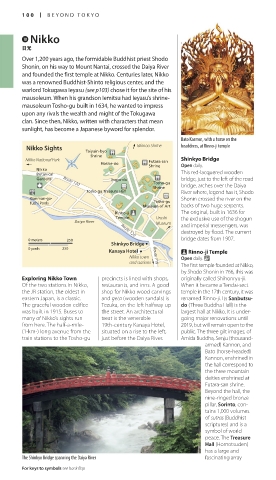
Nikko Sights Taiyuin-byo Takinoo Shrine headdress, at Rinno-ji temple
Shrine
Nikko National Park Futara-san Shinkyo Bridge
Hokke-do Shrine Open daily.
Nikko
Botanical This red-lacquered wooden
Gardens Jogyo-do bridge, just to the left of the road
Tosho-gu
Route 120
Shrine bridge, arches over the Daiya
Tosho-gu Treasure Hall River where, legend has it, Shodo
Ganman-ga- Shonin crossed the river on the
fuchi Pools Tosho-gu
Museum of Art backs of two huge serpents.
Rinno-ji The original, built in 1636 for
Temple Urushi the exclusive use of the shogun
Daiya River Museum and imperial messengers, was
destroyed by flood. The current
Route 120
0 meters 250 bridge dates from 1907.
Shinkyo Bridge
0 yards 250
Kanaya Hotel Rinno-ji Temple
Nikko town Route 119 Open daily. &
and stations
The first temple founded at Nikko,
by Shodo Shonin in 766, this was
Exploring Nikko Town precincts is lined with shops, originally called Shihonryu-ji.
Of the two stations in Nikko, restaurants, and inns. A good When it became a Tendai-sect
the JR station, the oldest in shop for Nikko wood carvings temple in the 17th century, it was
eastern Japan, is a classic. and geta (wooden sandals) is renamed Rinno-ji. Its Sanbutsu-
The graceful wooden edifice Tezuka, on the left halfway up do (Three Buddha Hall) is the
was built in 1915. Buses to the street. An architectural largest hall at Nikko. It is under-
many of Nikko’s sights run treat is the vener able going major renovations until
from here. The half-a-mile- 19th-century Kanaya Hotel, 2019, but will remain open to the
(1-km-) long avenue from the situated on a rise to the left, public. The three gilt images, of
train stations to the Tosho-gu just before the Daiya River. Amida Buddha, Senju (thousand-
armed) Kannon, and
Bato (horse-headed)
Kannon, enshrined in
the hall correspond to
the three mountain
deities enshrined at
Futara-san shrine.
Beyond the hall, the
nine-ringed bronze
pillar, Sorinto, con-
tains 1,000 volumes
of sutras (Buddhist
scriptures) and is a
symbol of world
peace. The Treasure
Hall (Homotsuden)
has a large and
The Shinkyo Bridge spanning the Daiya River fascinating array
For keys to symbols see back flap
100-101_EW_Tokyo.indd 100 12/09/16 11:28 am

