


Page 100 - (DK Eyewitness) Travel Guide - Tokyo
P. 100
98 BEY OND T OK Y O
8 Mount Fuji and the Fuji Five Lakes
Mount Fuji and the Fuji Five Lakes
At 12,390 ft (3,776 m), Mount Fuji is Japan’s highest peak
by far, its near-perfect cone floating lilac gray or snow-
capped above hilltops and low cloud. Dormant since
1707, the volcano first erupted 8–10,000 years ago. Its
upper slopes are loose volcanic ash, devoid of greenery
or streams. Before the 20th century, Mount Fuji was
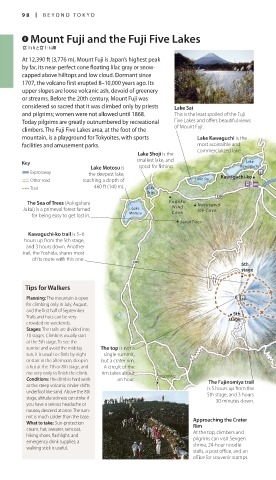
considered so sacred that it was climbed only by priests Lake Sai
and pilgrims; women were not allowed until 1868. This is the least spoiled of the Fuji
Today pilgrims are greatly outnumbered by recreational Five Lakes and offers beautiful views
climbers. The Fuji Five Lakes area, at the foot of the of Mount Fuji.
mountain, is a playground for Tokyoites, with sports Lake Kawaguchi is the
facilities and amusement parks. most accessible and
Lake Shoji is the commercialized lake.
smallest lake, and
Key Lake
Lake Motosu is good for fishing. Kawaguchi Chuo Expressway
Expressway the deepest lake,
Other road reaching a depth of Lake Sai Kawaguchi-ko
Trail 460 ft (140 m). Lake
Shoji
The Sea of Trees (Aokigahara Fugaku Narusawa
Jukai) is a primeval forest famed Lake Wind Ice Cave
Cave
for being easy to get lost in. Motosu
Sea of Trees
Kawaguchi-ko trail is 5–6
hours up from the 5th stage,
and 3 hours down. Another
trail, the Yoshida, shares most
of its route with this one.
5th
stage
•
Tips for Walkers
Planning: The mountain is open
for climbing only in July, August,
and the first half of September. • 5th
Trails and huts can be very stage • 5th stage
crowded on weekends.
Stages: The trails are divided into
10 stages. Climbers usually start
at the 5th stage. To see the
sunrise and avoid the midday The top is not a
sun, it is usual to climb by night single summit,
or start in the after noon, sleep in but a crater rim.
a hut at the 7th or 8th stage, and A circuit of the
rise very early to finish the climb. rim takes about Fujinomiya
Conditions: The climb is hard work an hour. The Fujinomiya trail
as the steep volcanic cinder shifts is 5 hours up from the
underfoot like sand. Above the 8th 5th stage, and 3 hours
stage, altitude sickness can strike: if 30 minutes down.
you have a serious head ache or
nausea, descend at once. The sum-
mit is much colder than the base. Approaching the Crater
What to take: Sun-protection Rim
cream, hat, sweater, raincoat, At the top, climbers and
hiking shoes, flashlight, and pilgrims can visit Sengen
emergency drink supplies; a shrine, 24-hour noodle
walking stick is useful.
stalls, a post office, and an
office for souvenir stamps.
098-099_EW_Tokyo.indd 98 12/09/16 11:24 am

