


Page 119 - (DK Eyewitness) Travel Guide - Tokyo
P. 119
WHERE T O EA T AND DRINK 117
Entering a are also impolite. Chopsticks
Restaurant or Bar should never be stuck upright
A set of noren (half-curtains) into bowls of rice or other
outside the door indicates that food; and food should never
a restaurant is open for business. be passed from one set of
Duck past the curtain, slide chopsticks to another. These
open the door, and pause at the gestures are associated with
threshold. If you do not have a funerary customs and are
reservation, indicate how many taboo at the dinner table.
people are in your group by When not using them, lay
raising the appropriate number your chopsticks on the rest
of fingers. In some restaurants, (hashi-oki) provided, or across
you may be asked to remove the lowest dish, keeping them
your shoes. Slippers will be uncrossed and parallel with
provided for walking around your side of the table.
on the wooden floor areas, or
if you need to use the toilet. Enjoying a meal while sitting on zabuton
Many Japanese restaurants in cushions at a low table Recommended
Restaurants
Tokyo offer Western-style tables
and chairs, plus counter seating to say “gochiso-sama deshita” The listings in this guide cover
looking into the open kitchen. (“it was a feast”). Calling the rich and diverse spectrum
They may also have traditional “sumimasen” (“excuse me!”) of different cuisines available
seating, or zashiki. This involves is the standard method of in Tokyo, from fine-dining
sitting at low tables on thin attracting the waiter’s attention. kaiseki restaurants serving
cushions (zabuton) on tatami Japanese drinking etiquette elegant banquets of beautifully
mats. Shoes and slippers are requires that you pour for the arranged traditional food to
never worn on tatami mats. other person and vice versa. hole-in-the-wall noodle
Women often sit with their legs When on the receiving end, pick restaurants where you can slurp
to the side, mermaid-style; the up your glass, supporting the some of Tokyo’s best ramen.
most common position for men bottom with the other hand. Eateries serving classics such
is cross-legged. The Japanese When a toast (kanpai) is made, as tempura, nabe, yakitori, and
don’t expect foreign guests to beer and whiskey glasses tonkatsu are well covered, as
sit in these positions, but it is ill- should be clinked; with sake, are the places to sample
mannered to stretch your legs cups are raised in a salute. monjayaki, the local version
out under a low table. Special Japanese meals often of okinomiyaki, the Japanese
chairs with backs but no legs comprise numerous courses, pancake you cook at your own
are often provided, or there may each served in separate bowls table. World foods haven’t been
be leg wells under the tables. or plates. In formal situations, left out as they are a big part
The counter is a great each person will have his own of eating out in Japan’s most
place to sit, especially in sushi individual vessels; more international city. The DK Choice
restaurants, since it gives prime informally, you serve yourself option identifies restaurants
views of the chefs preparing the from shared bowls in the that are especially good for a
food. Smoking is discouraged at middle of the table. Do not particular reason, be it a unique
seats close to the kitchen. Many eat from communal bowls, cultural location, such as a
Japanese restaurants have non- but transfer a few bite-sized former sumo stable turned
smoking sections, but only a portions onto a small plate in into a restaurant, or the chef’s
few are entirely non-smoking. front of you, using the serving novel take on traditional
chopsticks, if provided. Japanese cuisine.
It is quite acceptable to pick
Food Customs, up small bowls (such as rice
Etiquette and Taboos bowls) and hold them halfway
After they are seated, diners to the mouth. Soup is slurped
are often given oshibori, or directly from the bowl, but any
small damp towels. These are solid morsels should be picked
used to wipe hands (not the out with chopsticks (hashi).
face and neck), and then left If a morsel proves too difficult
on the table top for dabbing to handle, you can hold a
fingers and spills; do not place chopstick in each hand and
them on your lap. Never blow make a sawing motion to cut it.
your nose into the oshibori or Do not use chopsticks to
even a handkerchief in public. spear food, or to push it
The Japanese say “itadakimasu” straight from the bowl into
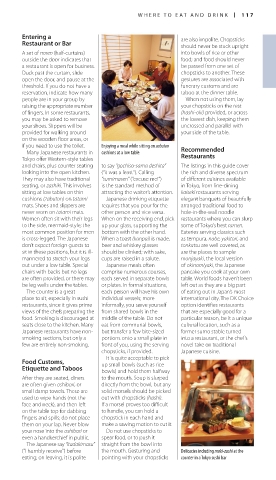
(“I humbly receive”) before the mouth. Gesturing and Delicacies including maki-zushi at the
eating; on leaving, it is polite pointing with your chopsticks counter in a Tokyo sushi bar
116-117_EW_Tokyo.indd 117 12/09/16 11:28 am

