


Page 25 - (DK Eyewitness) Travel Guide - Tokyo
P. 25
INTRODUCING T OK Y O 23
THE HISTORY
OF JAPAN
From the origins of the Japanese race to its military behavior in World War II, Japan’s
history is still subject to conjecture. What is indisputable is that the people of this
archipelago were able to avail themselves of the fruits of continental civilization
even as their isolation protected them from attack. As a result, Japan has one
of the most distinct of all the many Chinese-influenced cultures in Asia.
During glacial epochs when the sea queen of Yamatai, to the Chinese
level was low, Japan’s first inhabitants kingdom of Wei in 239, but Yamatai’s
may have reached the archipelago location is open to debate. Aristo cratic
overland from Sakhalin and Siberia, orders emerged, including that of the
China and Korea, or the Okinawa emperor, said to be descended from
islands. Crude stone tools found at the sun goddess Amaterasu. Figures
sites across Honshu, Japan’s main of high rank were buried in massive
island, may date back 40,000 years. kofun (tumuli), along with clay sculptures,
Recent discoveries posit the armor, mirrors, and jewelry.
emergence of the hunting and By the late 6th century, tribes that
gathering society known as Jomon had migrated to the fertile lands of
around 14,500 BC. Jomon pottery is the Yamato Plain in Western Honshu
among the world’s oldest and includes were engaged in a power struggle
vessels and figurines, particularly of over the intro duction of Buddhism.
women. Mounds of shells and other Prince Shotoku, appointed regent
evidence indicate that the diet included by Empress Suiko in 593, helped seal
fish, shellfish, deer, wild pigs, and wild victory for the pro-Buddhist camp.
plants and seeds. In the Kanto Plain (near In 701, the Taiho code, a penal and
Tokyo), the Jomon culture in its later administrative system based on the
stages included village-like groupings. Chinese model, was in place. Founded
Rice agriculture and bronze, iron, in 710 on the Yamato Plain, the city of
and other crafts are believed to have Nara became the grand diocese of
reached Japan via Korea during the Buddhism and one of Asia’s most
Yayoi period. The Yayoi people spread splendid cities in its 74-year spell as
from the southern island of Kyushu to Japan’s first capital. With the completion
Honshu over time, pushing the earlier of the Man’yoshu, the earliest known
inhabitants north. Chinese histories Japan ese poetry, in 759, the culture began
record a visit by an envoy of Himiko, to establish a clear voice of its own.
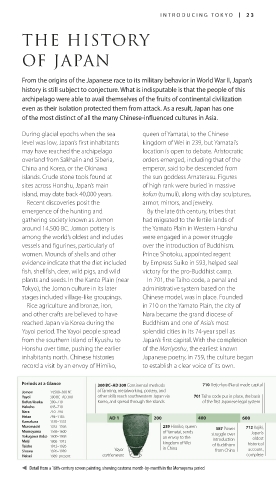
Periods at a Glance 300 BC–AD 300 Continental methods 710 Heijo-kyo (Nara) made capital
Jomon 14,500–300 BC of farming, metalworking, pottery, and
Yayoi 300 BC–AD 300 other skills reach southwestern Japan via 701 Taiho code put in place, the basis
Kofun/Asuka 300–710 Korea, and spread through the islands of the first Japanese legal system
Hakuho 645–710
Nara 710–794
Heian 794–1185 AD 1 200 400 600
Kamakura 1185–1333
Muromachi 1333–1568 239 Himiko, queen 587 Power 712 Kojiki,
Momoyama 1568–1600 of Yamatai, sends struggle over Japan’s
Tokugawa (Edo) 1600–1868 an envoy to the oldest
Meiji 1868–1912 kingdom of Wei introduction historical
Taisho 1912–1926 in China of Buddhism
Showa 1926–1989 Yayoi from China account,
Heisei 1989–present earthenware complete
Detail from a 16th-century screen painting, showing customs month-by-month in the Momoyama period
022-023_EW_Tokyo.indd 23 12/09/16 11:27 am

