


Page 202 - (DK Eyewitness) Travel Guide - Tokyo
P. 202
200 PHR ASE BOOK
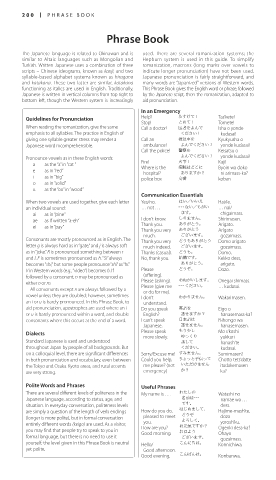
Phrase Book
The Japanese language is related to Okinawan and is used. There are several romanization systems; the
similar to Altaic languages such as Mongolian and Hepburn system is used in this guide. To simplify
Turkish. Written Japanese uses a combination of three romanization, macrons (long marks over vowels to
scripts – Chinese ideograms, known as kanji, and two indicate longer pronunci ation) have not been used.
syllable-based alphabet sys tems known as hiragana Japanese pronunciation is fairly straightforward, and
and katakana. These two latter are similar, katakana many words are “Japanized” versions of Western words.
functioning as italics are used in English. Traditionally, This Phrase Book gives the English word or phrase, followed
Japanese is written in vertical columns from top right to by the Japanese script, then the romanization, adapted to
bottom left, though the Western system is increasingly aid pronunciation.
In an Emergency
Guidelines for Pronunciation Help! Tas’kete!
Stop!
Tomete!
When reading the romanization, give the same Call a doctor! Isha o yonde
emphasis to all syllables. The practice in English of kudasai!
giving one syllable greater stress may render a Call an Kyukyusha o
Japanese word incomprehensible. ambulance! yonde kudasai!
Call the police! Keisatsu o
Pronounce vowels as in these English words: yonde kudasai!
a as the “a” in “cat ” Fire! Kaji!
Where is the
Byoin wa doko
e as in “red” hospital? ni arimass-ka?
i as in “big” police box koban
o as in “solid”
u as the “oo” in “wood”
Communication Essentials
When two vowels are used together, give each letter Yes/no. Hai/ie.
an individual sound: … not … … nai/
ai as in “pine” chigaimass.
ae as if written “a-eh” I don’t know. Shirimasen.
ei as in “pay” Thank you. Arigato.
Thank you very Arigato
much. gozaimass.
Consonants are mostly pronounced as in English. The Thank you very Domo arigato
letter g is always hard as in “gate,” and j is always soft much indeed. gozaimass.
as in “joke.” R is pronounced something between r Thanks (casual). Domo.
and l. F is sometimes pronounced as h. “Si” always No, thank you. Kekko dess,
becomes “shi,” but some people pronounce “shi” as “hi.” arigato.
V in Western words (e.g., “video”) becomes b. If Please Dozo.
followed by a consonant, n may be pronounced as (offering).
either n or m. Please (asking). Onegai shimass.
… kudasai.
Please (give me
All consonants except n are always followed by a or do for me).
vowel unless they are doubled; however, sometimes I don’t Wakarimasen.
an i or u is barely pronounced. In this Phrase Book, to understand.
aid pronunciation, apostrophes are used where an i Do you speak Eigo o
or u is barely pronounced within a word, and double English? hanasemass-ka?
consonants where this occurs at the end of a word. I can’t speak Nihongo wa
Japanese. hanasemasen.
Dialects Please speak Mo s’koshi
yukkuri
more slowly.
Standard Japanese is used and understood hanash’te
throughout Japan by people of all backgrounds. But kudasai.
on a colloquial level, there are significant differences Sorry/Excuse me! Sumimasen!
in both pronunciation and vocabulary, even between Could you help. Chotto tets’datte
the Tokyo and Osaka-Kyoto areas, and rural accents me please? (not itadakemasen-
are very strong. emergency) ka?
Polite Words and Phrases Useful Phrases
There are several different levels of politeness in the My name is …. Watashi no
Japanese language, according to status, age, and namae wa …
situation. In everyday conversation, polite ness levels dess.
are simply a question of the length of verb endings How do you do, Hajime-mash’te,
(longer is more polite), but in formal conversation pleased to meet dozo
entirely different words (keigo) are used. As a visitor, you. yorosh’ku.
Ogenki dess-ka?
How are you?
you may find that people try to speak to you in Good morning. Ohayo
formal language, but there is no need to use it gozaimass.
yourself; the level given in this Phrase Book is neutral Hello/ Konnichiwa.
yet polite. Good afternoon.
Good evening. Konbanwa.
200-204_EW_Tokyo.indd 200 12/09/16 11:29 am

