


Page 81 - (DK Eyewitness) Travel Guide - Tokyo
P. 81
F AR THER AFIELD 79
to bars and the best concen-
tration of live music venues
in Tokyo, most hosting an array
of eager emerging bands.
This grungy art village, a
haphazard mixture of ram-
shackle, late 20th-century
buildings, and pop art
facades covered in graffiti, is
unquestionably one of the city’s
fashion towns, though it remains
light years away from the chic
and sophisticated streets of
Omotesando or Akasaka. Its
numerous shops and stalls
offer an eclectic selection.
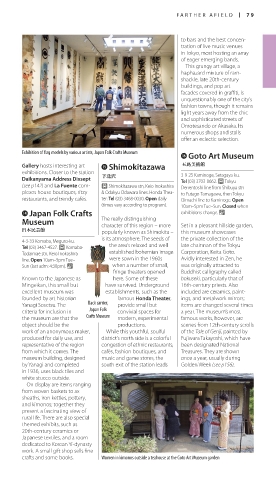
Exhibition of flag models by various artists, Japan Folk Crafts Museum
y Goto Art Museum
Gallery hosts interesting art t Shimokitazawa
exhibi tions. Closer to the station 3-9-25 Kaminoge, Setagaya-ku.
Daikanyama Address Dixsept Tel (03) 3703-0662. £ Tokyu
(see p142) and La Fuente com- £ Shimokitazawa stn, Keio Inokashira Denentoshi line from Shibuya stn
plexes house boutiques, ritzy & Odakyu Odawara lines. Honda Thea- to Futago-Tamagawa, then Tokyu
rest au rants, and trendy cafés. ter: Tel (03) 3468-0030. Open daily Oimachi line to Kaminoge. Open
(times vary according to program). 10am–5pm Tue–Sun. Closed when
r Japan Folk Crafts exhibitions change. &
Museum The really distinguishing Set in a pleasant hillside garden,
character of this region – more
popularly known as Shimokita – this museum showcases
4-3-33 Komaba, Meguro-ku. is its atmosphere. The seeds of the private collection of the
Tel (03) 3467-4527. £ Komaba- the area’s relaxed and well- late chairman of the Tokyu
Todaimae stn, Keio Inokashira established bohemian image Corporation, Keita Goto.
line. Open 10am–5pm Tue– were sown in the 1960s Avidly interested in Zen, he
Sun (last adm: 4:30pm). & when a number of small, was originally attracted to
fringe theaters opened Buddhist calligraphy called
Known to the Japanese as here. Some of these bokuseki, particularly that of
Mingeikan, this small but have survived. Underground 16th-century priests. Also
excellent museum was establish ments, such as the included are ceramics, paint-
founded by art historian famous Honda Theater, ings, and metalwork mirrors;
Yanagi Sosetsu. The Back carrier, provide small but items are changed several times
criteria for inclusion in Japan Folk convivial spaces for a year. The museum’s most
the museum are that the Crafts Museum modern, experimental famous works, however, are
object should be the productions. scenes from 12th-century scrolls
work of an anonymous maker, While this youthful, soulful of the Tale of Genji, painted by
produced for daily use, and district’s north side is a color ful Fujiwara Takayoshi, which have
representative of the region congestion of ethnic restaurants, been designated National
from which it comes. The cafés, fashion bouti ques, and Treasures. They are shown
museum building, designed music and game stores, the once a year, usually during
by Yanagi and completed south exit of the station leads Golden Week (see p156).
in 1936, uses black tiles and
white stucco outside.
On display are items ranging
from woven baskets to ax
sheaths, iron kettles, pottery,
and kimonos; together they
present a fascinating view of
rural life. There are also special
themed exhibits, such as
20th-century ceramics or
Japanese textiles, and a room
dedicated to Korean Yi-dynasty
work. A small gift shop sells fine
crafts and some books. Women in kimonos outside a teahouse at the Goto Art Museum garden
078-079_EW_Tokyo.indd 79 12/09/16 11:27 am

