


Page 77 - (DK Eyewitness) Travel Guide - Tokyo
P. 77
F AR THER AFIELD 75
5 Gokoku-ji Temple the ceiling in paintings that float
over transoms covered with
colorful carvings of peonies.
Gokoku-ji stn, Yurakucho line. Completing the ensemble
Tel (03) 3941-0764. of buildings that have been
designated Important Cultural
Given Gokoku-ji’s historical Properties are an imposing bell
credentials as one of Edo’s tower and a rare two-tiered
most important temples, pagoda, a popular subject
and its survival in the face for painters.
of earthquakes, fires, and air
raids during World War II, the 6 Zoshigaya
absence of visitors, especially
on weekdays, is surprising.
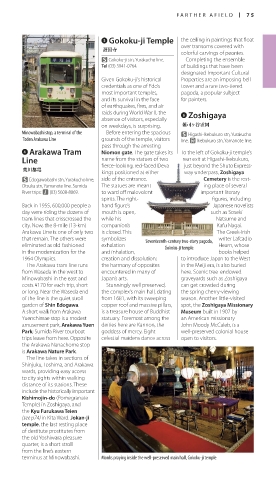
Minowabashi stop, a terminal of the Before entering the spacious Higashi-Ikebukuro stn, Yurakucho
Toden Arakawa Line grounds of the temple, visitors line. £ Ikebukuro stn, Yamanote line.
pass through the arresting
4 Arakawa Tram Niomon gate. The gate takes its To the left of Gokoku-ji temple’s
Line name from the statues of two rear exit at Higashi-Ikebukuro,
fierce-looking, red-faced Deva just beyond the Shuto Express-
kings positioned at either way underpass, Zoshigaya
Edogawabashi stn, Yurakucho line; side of the entrance. Cemetery is the rest-
Otsuka stn, Yamanote line. Sumida The statues are meant ing place of several
River trips: n (03) 5608-8869. to ward off malev olent important literary
spirits. The right- fig ures, including
Back in 1955, 600,000 people a hand figure’s Japanese novelists
day were riding the dozens of mouth is open, such as Soseki
tram lines that crisscrossed the while his Natsume and
city. Now, the 8-mile (13-km) compan ion’s Kafu Nagai.
Arakawa Line is one of only two is closed. This The Greek-Irish
that remain. The others were symbo lizes Seventeenth-century two-story pagoda, writer Lafcadio
eliminated as old-fashioned exhalation Gokoku-ji temple Hearn, whose
in the modern iza tion for the and inhalation, books helped
1964 Olympics. creation and dissolution; to intro duce Japan to the West
The Arakawa tram line runs the harmony of opposites in the Meiji era, is also buried
from Waseda in the west to encountered in many of here. Scenic tree-endowed
Minowabashi in the east and Japan’s arts. graveyards such as Zoshigaya
costs ¥170 for each trip, short Stunningly well preserved, can get crowded during
or long. Near the Waseda end the complex’s main hall, dating the spring cherry-viewing
of the line is the quiet stroll from 1681, with its sweep ing season. Another little-visited
garden of Shin Edogawa. copper roof and massive pillars, spot, the Zoshigaya Missionary
A short walk from Arakawa is a treasure house of Buddhist Museum built in 1907 by
Yuenchimae stop is a modest statuary. Foremost among the an American missionary
amuse ment park, Arakawa Yuen deities here are Kannon, the John Moody McCaleb, is a
Park; Sumida River tourboat goddess of mercy. Eight well-preserved colonial house
trips leave from here. Oppo site celestial maidens dance across open to visitors.
the Arakawa Nanachome stop
is Arakawa Nature Park.
The line takes in sections of
Shinjuku, Toshima, and Arakawa
wards, providing easy access
to city sights within walking
distance of its stations. These
include the historically important
Kishimojin-do (Pome granate
Temple) in Zoshigaya, and
the Kyu Furukawa Teien
(see p74) in Kita Ward. Jokan-ji
temple, the last resting place
of destitute prostitutes from
the old Yoshiwara pleasure
quarter, is a short stroll
from the line’s eastern
terminus at Minowabashi. Monks praying inside the well-preserved main hall, Gokoku-ji temple
074-075_EW_Tokyo.indd 75 12/09/16 11:27 am

