


Page 78 - (DK Eyewitness) Travel Guide - Tokyo
P. 78
76 T OK Y O AREA B Y AREA
7 Ryogoku District
Map 4 E4–5. Ryogoku stn, Toei-Oedo
line. £ Ryogoku stn, JR Sobu line. Sumo
Museum: 1-3-28 Yokoami, Sumida-ku.
Tel (03) 3622-0366. Open 10am–
4:30pm Mon–Fri. Closed Sat, Sun &
public hols. Edo-Tokyo Museum: 1-4-1
Yokoami, Sumida-ku. Tel (03) 3626-
9974. Open 9:30am–5:30pm Tue–Sun
(7:30pm Sat). &
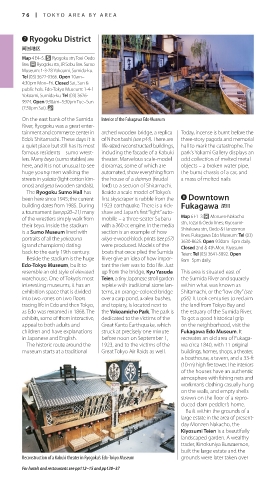
On the east bank of the Sumida Interior of the Fukagawa Edo Museum
River, Ryogoku was a great enter-
tainment and commerce center in arched wooden bridge, a replica Today, incense is burnt before the
Edo’s Shitamachi. These days it is of Nihonbashi (see p44). There are three-story pagoda and memorial
a quiet place but still has its most life-sized reconstructed buildings, hall to mark the catastrophe. The
famous resi dents – sumo wrest- including the facade of a Kabuki park’s Yokami Gallery displays an
lers. Many beya (sumo stables) are theater. Marvelous scale-model odd collection of melted metal
here, and it is not unusual to see dioramas, some of which are objects – a broken water pipe,
huge young men walking the automated, show everything from the burnt chassis of a car, and
streets in yukata (light cotton kim- the house of a daimyo (feudal a mass of melted nails
onos) and geta (wooden sandals). lord) to a section of Shitamachi.
The Ryogoku Sumo Hall has Beside a scale model of Tokyo’s
been here since 1945; the current first skyscraper is rubble from the 8 Downtown
building dates from 1985. During 1923 earthquake. There is a rick- Fukagawa
a tournament (see pp20–21) many shaw and Japan’s first “light” auto-
of the wrestlers simply walk from mobile – a three-seater Subaru Map 6 F1–3.£ Monzen-Nakacho
stn, Tozai & Oedo lines; Kiyosumi-
their beya. Inside the stadium with a 360 cc engine. In the media Shirakawa stn, Oedo & Hanzomon
is a Sumo Museum lined with section is an example of how lines. Fukagawa Edo Museum: Tel (03)
portraits of all the yokozuna ukiyo-e wood-block prints (see p57) 3630-8625. Open 9:30am–5pm daily.
(grand champions) dating were pro duced. Models of the Closed 2nd & 4th Mon. Kiyosumi
back to the early 19th century. boats that once plied the Sumida Teien: Tel (03) 3641-5892. Open
Beside the stadium is the huge River give an idea of how impor- 9am–5pm daily.
Edo-Tokyo Museum, built to tant the river was to Edo life. Just
resemble an old style of elevated up from the bridge, Kyu Yasuda This area is situated east of
warehouse. One of Tokyo’s most Teien, a tiny Japanese stroll garden the Sumida River and squarely
interesting museums, it has an replete with traditional stone lan- within what was known as
exhibition space that is divided terns, an orange-colored bridge Shitamachi, or the “low city” (see
into two zones on two floors over a carp pond, azalea bushes, p56). It took centuries to reclaim
tracing life in Edo and then Tokyo, and topiary, is located next to the land from Tokyo Bay and
as Edo was renamed in 1868. The the Yokoami cho Park. The park is the estuary of the Sumida River.
exhibits, some of them interactive, dedicated to the victims of the To get a good historical grip
appeal to both adults and Great Kanto Earthquake, which on the neighborhood, visit the
children and have explana tions struck at precisely one minute Fukagawa Edo Museum. It
in Japanese and English. before noon on September 1, recreates an old area of Fukaga-
The historic route around the 1923, and to the victims of the wa circa 1840, with 11 original
museum starts at a traditional Great Tokyo Air Raids as well. buildings, homes, shops, a theater,
a boathouse, a tavern, and a 33-ft
(10-m) high fire tower. The interiors
of the houses have an authentic
atmo sphere with fishing nets and
workman’s clothing casually hung
on the walls, and empty shells
strewn on the floor of a repro-
duced clam peddler’s home.
Built within the grounds of a
large estate in the area of present-
day Monzen Nakacho, the
Kiyosumi Teien is a beautifully
landscaped garden. A wealthy
trader, Kinoku niya Bunzaemon,
built the large es tate and the
Reconstruction of a Kabuki theater in Ryogoku’s Edo-Tokyo Museum grounds were later taken over
For hotels and restaurants see pp112–15 and pp130–37
076-077_EW_Tokyo.indd 76 12/09/16 11:24 am

