


Page 54 - Forbes - USA (February 2018)
P. 54
TION
                                                SPECIAL ADVERTISTING SECTION
                                                SPECIAL
                                                                SEC
                                                      AD
                                                        VER
                                                          TISTING
                                             JAPAN:


                                        LOOKS TO THE FUTURE

                           Japanese Companies Ideally Positioned to Power a B2C Revival in 2018.


        Japanese companies face a unique and envy-
        inducing opportunity in 2018. Those that are
        prepared to take on more risk in the markets
        while channeling fund stockpiles towards
        workers have the chance to kick-start the
        business-to-consumer (B2C) sector, after
        years of relying on exports and the busi-
        ness-to-business (B2B) market. At the same
        time, artificial intelligence (AI) and robotics
        are playing an increasingly important role
        in the workplace, and companies with the
        foresight to adapt to unfolding technologi-
        cal developments will be in the driving seat
        when it comes to cheaper unit-per-cost
        manufacturing.
          Japanese companies have built up in-
        house fund stockpiles to levels now esti-
        mated to outstrip gross domestic product
        (GDP) by as much as a multiple of three.
        Those funds have been progressively squir-
        reled away since the global financial crisis,
        mirroring moves by risk-averse individuals
        to remove funds from the markets and keep
        them in low-interest bank accounts.

        Fresh Incentives
        But Japan now stands at a crossroads. The
        risk-off stance of both companies and indi-
        viduals will be difficult to maintain amid a
        shrinking labor market, which has also seen a
        depletion of experience and talent as skilled
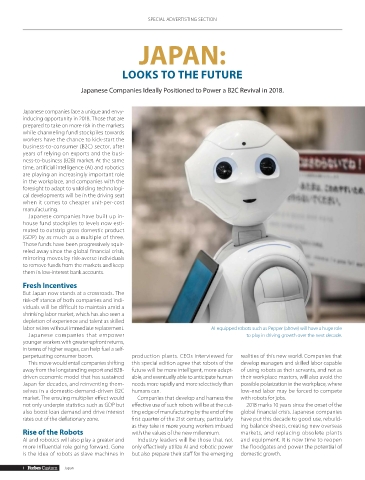
        labor retires without immediate replacement.                AI -equipped robots such as Pepper (above) will have a huge role
          Japanese companies that empower                                      to play in driving growth over the next decade.
        younger workers with greater upfront returns,
        in terms of higher wages, can help fuel a self-
        perpetuating consumer boom.        production plants. CEOs interviewed for   realities of this new world. Companies that
          This move would entail companies shifting   this special edition agree that robots of the   develop managers and skilled labor capable
        away from the longstanding export and B2B-  future will be more intelligent, more adapt-  of using robots as their servants, and not as
        driven economic model that has sustained   able, and eventually able to anticipate human   their workplace masters, will also avoid the
        Japan for decades, and reinventing them-  needs more rapidly and more selectively than   possible polarization in the workplace, where
        selves in a domestic-demand-driven B2C   humans can.                 low-end labor may be forced to compete
        market. The ensuing multiplier effect would   Companies that develop and harness the   with robots for jobs.
        not only underpin statistics such as GDP but   effective use of such robots will be at the cut-  2018 marks 10 years since the onset of the
        also boost loan demand and drive interest   ting edge of manufacturing by the end of the   global financial crisis. Japanese companies
        rates out of the deflationary zone.  first quarter of the 21st century, particularly   have put this decade to good use, rebuild-
                                           as they take in more young workers imbued   ing balance sheets, creating new overseas
        Rise of the Robots                 with the values of the new millennium.  markets, and replacing obsolete plants
        AI and robotics will also play a greater and   Industry leaders will be those that not   and equipment. It is now time to reopen
        more influential role going forward. Gone   only effectively utilize AI and robotic power   the floodgates and power the potential of
        is the idea of robots as slave machines in   but also prepare their staff for the emerging   domestic growth.

        1            Japan

