


Page 73 - Amphibian
P. 73
FLASH COLORATION  Markings           MOTTLED         Mottled skin                 PREDATOR  An animal that
        of bright color on an animal, revealed only   Dappled; having                     hunts and kills other animals
        when the animal moves. The sudden flash   spots, streaks, or patches of           for its food
        of unexpected and vivid color distracts   different colors
        potential predators.                                                              SALAMANDER  Any of the
                                             MUCUS  A slippery                           nocturnal amphibians of the order
        FROGLET                              secretion created by                       Caudata. Salamanders are typically
        A juvenile frog,                     mucous glands for lubrication and         terrestrial, resemble lizards, and
        resembling a                         protection against bacteria                return to water only to breed.
        small adult with                                                 Blue poison
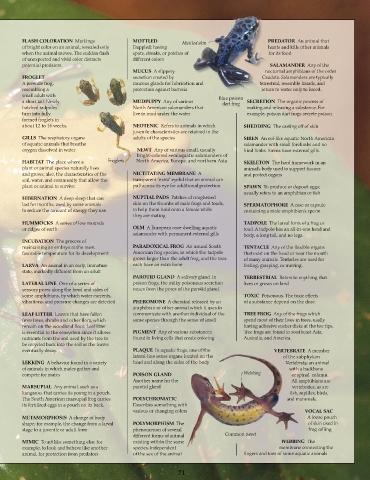
        a short tail. Newly                  MUDPUPPY  Any of various      dart frog  SECRETION  The organic process of
        hatched tadpoles                     North American salamanders that       making and releasing a substance. For
        turn into fully                      live in mud under the water           example, poison dart frogs secrete poison.
        formed froglets in
        about 12 to 16 weeks.                NEOTENIC  Refers to animals in which   SHEDDING  The casting off of skin
                                             juvenile characteristics are retained in the
        GILLS  The respiratory organs        adults of the species                SIREN  An eel-like aquatic North American
        of aquatic animals that breathe                                           salamander with small forelimbs and no
        oxygen dissolved in water             NEWT  Any of various small, usually   hind limbs. Sirens have external gills.
                                              bright-colored semiaquatic salamanders of
        HABITAT  The place where a   Froglets  North America, Europe, and northern Asia  SKELETON  The hard framework in an
        plant or animal species naturally lives                                   animal’s body used to support tissues
        and grows; also, the characteristics of the   NICTITATING MEMBRANE  A     and protect organs
        soil, water, and community that allow the   transparent “extra” eyelid that an animal can
        plant or animal to survive           pull across its eye for additional protection  SPAWN  To produce or deposit eggs;
                                                                                  usually refers to an amphibian or fish
        HIBERNATION  A deep sleep that can   NUPTIAL PADS  Patches of roughened
        last for months, used by some animals   skin on the thumbs of male frogs and toads,   SPERMATOPHORE  A case or capsule
        to reduce the amount of energy they use  to help them hold onto a female while   containing a male amphibian’s sperm
                                             they are mating
        HUMMOCKS  A series of low mounds                                          TADPOLE  The larval form of a frog or
        or ridges of earth                   OLM  A European cave-dwelling aquatic   toad. A tadpole has an all-in-one head and
                                             salamander with permanent external gills  body, a long tail, and no legs.
        INCUBATION  The process of
        maintaining an embryo at the most    PARADOXICAL FROG  An unusal South    TENTACLE  Any of the flexible organs
        favorable temperature for its development  American frog species, in which the tadpole   that exist on the head or near the mouth
                                             grows larger than the adult frog, and the toes   of many animals. Tentacles are used for
        LARVA  An animal in an early, immature   each have an extra bone          feeling, grasping, or moving.
        state, markedly different from an adult
                                             PAROTID GLAND  A salivary gland. In   TERRESTRIAL  Refers to anything that
        LATERAL LINE  One of a series of     poison frogs, the milky poisonous secretion   lives or grows on land
        sensory pores along the head and sides of   oozes from the pores of the parotid gland.
        some amphibians, by which water currents,                                 TOXIC  Poisonous. The toxic effects
        vibrations, and pressure changes are detected  PHEROMONE  A chemical released by an   of a substance depend on the dose.
                                             amphibian or other animal which it uses to
        LEAF LITTER  Leaves that have fallen   communicate with another individual of the   TREE FROG  Any of the frogs which
        from trees, shrubs and other flora, which   same species through the sense of smell  spend most of their lives in trees, usally
        remain on the woodland floor. Leaf litter                                 having adhesive sucker disks at the toe tips.
        is essential to the ecosystem since it allows   PIGMENT  Any of various substances   Tree frogs are found in southeast Asia,
        nutrients from the soil used by the tree to   found in living cells that create coloring  Australia, and America.
        be recycled back into the soil as the leaves
        eventually decay.                    PLAQUE  In aquatic frogs, one of the           VERTEBRATE  A member
                                             lateral-line sense organs located on the          of the subphylum
        LEKKING  A behavior found in a variety   head and along the sides of the body           Vertebrata; an animal
        of animals in which males gather and                                                     with a backbone
        compete for mates                    POISON GLAND                         Webbing         or spinal  column.
                                             Another name for the                                 All amphibians are
        MARSUPIAL  Any animal, such as a     parotid gland                                        vertebrates, as are
        kangaroo, that carries its young in a pouch.                                             fish, reptiles, birds,
        The South American marsupial frog carries   POLYCHROMATIC                               and mammals.
        its fertilized eggs in a pouch on its back.  Describes something with
                                             various or changing colors                               VOCAL SAC
        METAMORPHOSIS  A change of body                                                                A loose pouch
        shape; for example, the change from a larval   POLYMORPHISM  The                               of skin used in
        stage to a juvenile or adult form    phenomenon of several                                     frog calling
                                             different forms of animal      Common newt
        MIMIC  To act like something else; for   existing within the same                     WEBBING  The
        example, to look and behave like another   species, independent                      membrane connecting the
        animal, for protection from predators  of the sex of the animal           fingers and toes of some aquatic animals


                                                             1

