


Page 32 - World of Animals - Issue #28 Magazine
P. 32
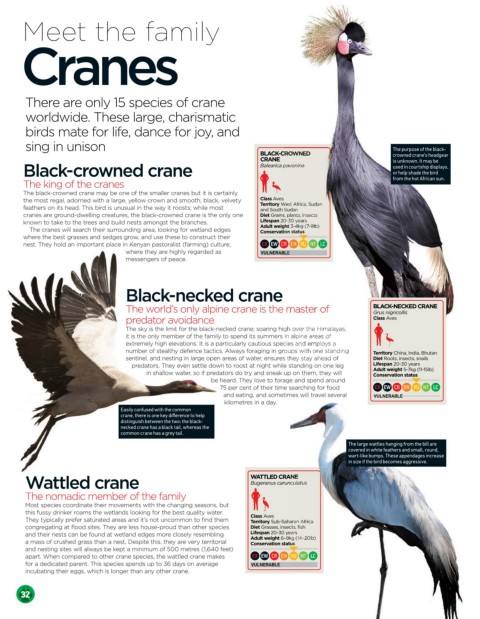
Meet the family
Cranes
There are only 15 species of crane
worldwide. These large, charismatic
birds mate for life, dance for joy, and
sing in unison
BLA CK -CRO WNED The purpose of the black-
BLACK-CROWNED
crowned crane’s headgear
CRANE is unknown. It may be
Black-crowned crane Balearica pavonina used in courtship displays,
alearica pa
B
v
onina
or help shade the bird
The king of the cranes from the hot African sun.
The black-crowned crane may be one of the smaller cranes but it is certainly
the most regal, adorned with a large, yellow crown and smooth, black, velvety Class Aves
West Africa, Sudan
feathers on its head. This bird is unusual in the way it roosts; while most Territory West Africa, Sudan
and South Sudan
and South Sudan
cranes are ground-dwelling creatures, the black-crowned crane is the only one Diet Grains, plants, insects
Grains, plants, insects
20-30 years
known to take to the trees and build nests amongst the branches. Lifespan 20-30 years
Adult weight 3-4kg (7-9lb)
The cranes will search their surrounding area, looking for wetland edges Adult weight 3-4kg (7-9lb)
Conservation status
Conservation status
where the best grasses and sedges grow, and use these to construct their
nest. They hold an important place in Kenyan pastoralist (farming) culture,
where they are highly regarded as VULNERABLE
VULNERABLE
messengers of peace.
Black-necked crane
The world’s only alpine crane is the master of
T h e w o r l d ’ s o n l y a l p i n e c r a n e i s t h e m a s t e r o f BLACK-NECKED CRANE
Grus nigricollis
predator avoidance Class Aves
s t
c
o
k
n
t f
-
h
y i
a
e b
a
l
r t
r
i
n
a
k
e
m
d c
; s
e
i
o
e
e l
c
h
The sky is the limit for the black-necked crane; soaring high over the Himalayas, ,
T
e H
h
v
h
r t
e
y
a
s
a
m
i
l
a
i
g
n
e s
i
r
k
h o
g h
a
m
i
s o
l
h
e f
f t
m
a
m
u
f
y t
i
d i
n
n
n a
s s
l
p
t
e
o s
e
r
r
e
s i
e a
p
r o
i
it is the only member of the family to spend its summers in alpine areas of
l
n
t i
e
s t
m
e o
y m
b
e
h
e
o
i
y h
l
r
l
y c
u
l
a
i
u
t
h e
g
a
extremely high elevations. It is a particularly cautious species and employs a
d e
n
s a
e
m
y
s a
o
p
l
e
e
p
s s
u
m
r
i
x
c
t
e
c
a
s a p
s
t
o
e
r
t
t i
a
i
. I
l
v
i
n
i
n
r
i
e
o
u
e
n g
a
b
m
t
c
g i
t
e
f
n
e s
a
n
g
i
n
d
s w
n
p
u
e t
number of stealthy defence tactics. Always foraging in groups with one standing Territory China, India, Bhutan
h o
n
t
c
i
r o
f s
y
h
a
l
t
s f
g
a
o
s
e
w
l
. A
r
a
y d
c
t
t
r
g
e
s sentinel, and nesting in large open areas of water, ensures they stay ahead of Diet Roots, insects, snails
e
y s
h
n l
d o
s o
a
r
a
f
s
e
a
y a
t
f w
h
e
a
e
s
g i
n
i
i
r
r
u
t
p
, e
, a
l
e
e
n
n
n
n a
s t
d n
t
n
a
e
e
e o
predators. They even settle down to roost at night while standing on one leg Lifespan 20-30 years
in shallow water, so if predators do try and sneak up on them, they will Adult weight 5-7kg (11-15lb)
Conservation status
be heard. They love to forage and spend around
75 per cent of their time searching for food
and eating, and sometimes will travel several VULNERABLE
kilometres in a day.
Easily confused with the common
crane, there is one key difference to help
distinguish between the two: the black-
necked crane has a black tail, whereas the
common crane has a grey tail.
The large wattles hanging from the bill are
covered in white feathers and small, round,
wart-like bumps. These appendages increase
in size if the bird becomes aggressive.
Wattled crane W A TTLED CRANE tus
WATTLED CRANE
Buger
Bugeranus carunculatus
anus caruncula
The nomadic member of the family
Most species coordinate their movements with the changing seasons, but
this fussy drinker roams the wetlands looking for the best quality water. Class Aves
They typically prefer saturated areas and it’s not uncommon to find them Territory Sub-Saharan Africa
Sub-Saharan Africa
congregating at flood sites. They are less house-proud than other species Diet Grasses, insects, fish
Grasses, insects, fi
sh
20-30 years
and their nests can be found at wetland edges more closely resembling Lifespan 20-30 years
Adult weight 6–9kg (14–20lb)
6–9kg (14–20lb)
a mass of crushed grass than a nest. Despite this, they are very territorial Conservation status
Conservation status
and nesting sites will always be kept a minimum of 500 metres (1,640 feet)
apart. When compared to other crane species, the wattled crane makes
for a dedicated parent. This species spends up to 36 days on average VULNERABLE
incubating their eggs, which is longer than any other crane.
32

