


Page 30 - World of Animals - Issue #28 Magazine
P. 30
Interview with a…

           Wildlife vet


            Emma Lloret from Wildlife Aid lifts the lid on life as a wildlife vet, from

            treating British wildlife to taking part in vital conservation projects

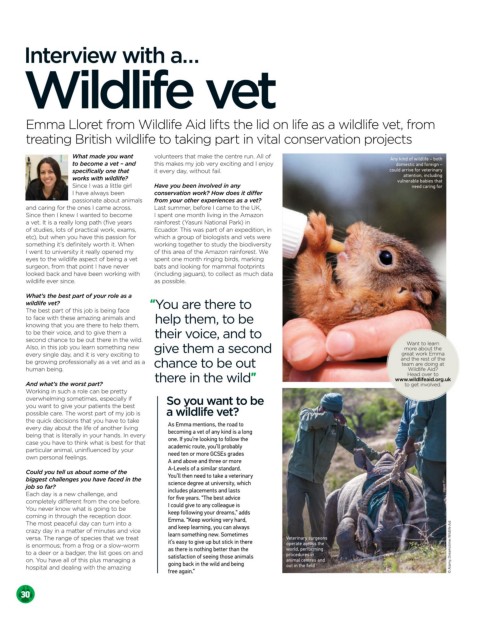
                         What made you want    volunteers that make the centre run. All of                     Any kind of wildlife – both
                         to become a vet – and   this makes my job very exciting and I enjoy                     domestic and foreign –

                         specifically one that   it every day, without fail.                                    could arrive for veterinary
                                                                                                                   attention, including
                         works with wildlife?                                                                    vulnerable babies that
                         Since I was a little girl   Have you been involved in any                                   need caring for
                         I have always been    conservation work? How does it differ
                         passionate about animals   from your other experiences as a vet?
            and caring for the ones I came across.   Last summer, before I came to the UK,
            Since then I knew I wanted to become   I spent one month living in the Amazon
            a vet. It is a really long path (five years   rainforest (Yasuni National Park) in

            of studies, lots of practical work, exams,   Ecuador. This was part of an expedition, in
            etc), but when you have this passion for   which a group of biologists and vets were

            something it’s definitely worth it. When   working together to study the biodiversity
            I went to university it really opened my   of this area of the Amazon rainforest. We
            eyes to the wildlife aspect of being a vet   spent one month ringing birds, marking
            surgeon, from that point I have never   bats and looking for mammal footprints
            looked back and have been working with   (including jaguars), to collect as much data
            wildlife ever since.               as possible.
            What’s the best part of your role as a
            wildlife vet?                     “You are there to
            The best part of this job is being face
            to face with these amazing animals and   help them, to be
            knowing that you are there to help them,
            to be their voice, and to give them a   their voice, and to
            second chance to be out there in the wild.                                                              Want to learn
            Also, in this job you learn something new   give them a second                                         more about the
            every single day, and it is very exciting to                                                          great work Emma
            be growing professionally as a vet and as a   chance to be out                                        and the rest of the
                                                                                                                  team are doing at
            human being.                                                                                            Wildlife Aid?
                                               there in the wild”                                                www.wildlifeaid.org.uk
                                                                                                                    Head over to
            And what’s the worst part?                                                                             to get involved.
            Working in such a role can be pretty
            overwhelming sometimes, especially if   So you want to be
            you want to give your patients the best
            possible care. The worst part of my job is   a wildlife vet?
            the quick decisions that you have to take
            every day about the life of another living   As Emma mentions, the road to
            being that is literally in your hands. In every   becoming a vet of any kind is a long
            case you have to think what is best for that   one. If you’re looking to follow the

            particular animal, uninfluenced by your   academic route, you’ll probably
            own personal feelings.                 need ten or more GCSEs grades
                                                   A and above and three or more
                                                   A-Levels of a similar standard.
            Could you tell us about some of the
            biggest challenges you have faced in the   You’ll then need to take a veterinary
            job so far?                            science degree at university, which
            Each day is a new challenge, and       includes placements and lasts

            completely different from the one before.   for five years. “The best advice
            You never know what is going to be     I could give to any colleague is
            coming in through the reception door.   keep following your dreams,” adds
            The most peaceful day can turn into a   Emma. “Keep working very hard,
            crazy day in a matter of minutes and vice   and keep learning, you can always
            versa. The range of species that we treat   learn something new. Sometimes   Veterinary surgeons
            is enormous; from a frog or a slow-worm   it’s easy to give up but stick in there   operate across the              © Alamy; Dreamstime; Wildlife Aid
                                                                                   world, performing
            to a deer or a badger, the list goes on and   as there is nothing better than the   procedures in
            on. You have all of this plus managing a   satisfaction of seeing those animals   animal centres and

            hospital and dealing with the amazing   going back in the wild and being   out in the field
                                                   free again.”
           30

