


Page 33 - World of Animals - Issue #28 Magazine
P. 33
Cranes
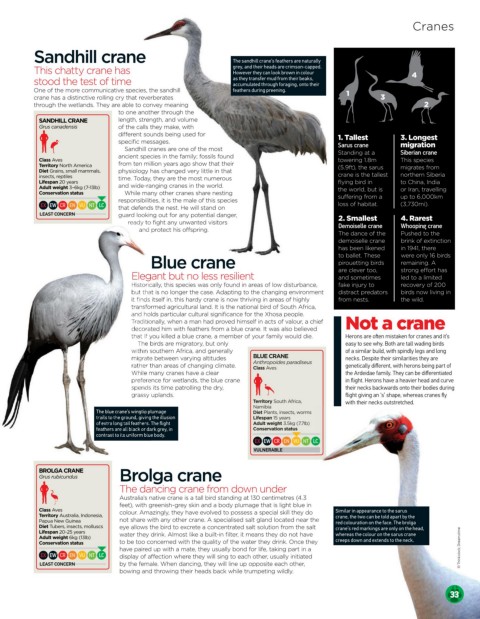
Sandhill crane The sandhill crane’s feathers are naturally
This chatty crane has grey, and their heads are crimson-capped. 4
However they can look brown in colour
stood the test of time as they transfer mud from their beaks,
accumulated through foraging, onto their
One of the more communicative species, the sandhill feathers during preening. 1
crane has a distinctive rolling cry that reverberates 3
through the wetlands. They are able to convey meaning 2
to one another through the
SANDHILL CRANE length, strength, and volume
Grus canadensis of the calls they make, with
different sounds being used for 1. Tallest 3. Longest
specifi c messages. Sarus crane migration
Sandhill cranes are one of the most Siberian crane
ancient species in the family; fossils found Standing at a
Class Aves towering 1.8m This species
Territory North America from ten million years ago show that their (5.9ft), the sarus migrates from
Diet Grains, small mammals, physiology has changed very little in that
insects, reptiles time. Today, they are the most numerous crane is the tallest northern Siberia
Lifespan 20 years flying bird in to China, India
Adult weight 3–6kg (7-13lb) and wide-ranging cranes in the world. the world, but is or Iran, travelling
Conservation status While many other cranes share nesting suffering from a up to 6,000km
responsibilities, it is the male of this species loss of habitat. (3,730mi).
that defends the nest. He will stand on
y
an
gu
guard looking out for any potential danger,
p
g
o
u
l
ook
n
or
g
ar
f
d
e
a
o
LEAST CONCERN gu ar d l ook i i n g o u t t f or an y p o t t e e n t t i i a l l d an g e r r , , 2. Smallest 4. Rarest
n
an
d
g
s
g
h
t a
d v
t a
h
d v
d
d
i
a
a
i
y t
s
y t
o fi
o fi
t
w
w
n
n
r
t
n
o
o
a
a
n
e
i
y u
e
n
n
y u
s
s
r
i
t
t
r r
ready to fight any unwanted visitors Demoiselle crane Whooping crane
e
e
g
d p
and protect his offspring.
n
a a n d p r r o t t e e c t h i i s o f f f f s s p r r i i n g . .
c
p
s o
o
t h
n
The dance of the Pushed to the
demoiselle crane brink of extinction
has been likened in 1941, there
Blue crane to ballet. These were only 16 birds
remaining. A
pirouetting birds
Elegant but no less resilient
E l e g a n t b u t n o l e s s r e s i l i e n t are clever too, strong effort has
led to a limited
and sometimes
Historically, this species was only found in areas of low disturbance,
H i s t o r i c a l l y , t h i s s p e c i e s w a s o n l y f o u n d i n a r e a s o f l o w d i s t u r b a n c e , fake injury to recovery of 200
a
o
p
o t
h
g t
e c
s n
. Ad
n
s
but that is no longer the case. Adapting to the changing environment distract predators birds now living in
a
o l
t i
t
h
i
b
t
n
n
a
r
i
r t
t t
m
g e
h
e c
i
n
u
o
g
n
v
a
h
e
e
n
n
e
g
w t
r
l
h
y
f h
e
i it finds itself in, this hardy crane is now thriving in areas of highly from nests. the wild.
l
d
s n
g
y c
n
o
i
e i
, t
f i
h
a
s h
i
i
s o
r
n
n
s i
t
v
r
h
t fi
a
r
d
a
n
i
s
e
g i
n a
u
s
a
u
r
l b
t
i
i
c
r
r
a
l l
t i
f S
a
r
i
f
c
r
l
a
n
h A
t
u
. I
s t
d o
a
o
t transformed agricultural land. It is the national bird of South Africa, ,
n
n
e
d
e n
m
i
t
r
o
d a
g
h
f
a
o
an d ho l d s p ar t i c u l ar c u l t u r a l s i g n i fi c anc e f or t h e X ho s a p e op l e .
and holds particular cultural significance for the Xhosa people.
Traditionally, when a man had proved himself in acts of valour, a chief
T r a d i t i o n a l l y , w h e n a m a n h a d p r o v e d h i m s e l f i n a c t s o f v a l o u r , a c h i e f Not a crane
decorated him with feathers from a blue crane. It was also believed
d e c o r a t e d h i m w i t h f e a t h e r s f r o m a b l u e c r a n e . I t w a s a l s o b e l i e v e d
u
a
e
n
l
i
a
i
h
e c
b
m
u k
l
r o
y w
e
e
r f
o
l
a
t i
f y
u
m
o
e
e
, a m
d a b
that if you killed a blue crane, a member of your family would die. . Herons are o en mistaken for cranes and it’s
o
d d
l
f y
r
l
t
i
u
u
r
, b
y
t o
e m
r
s a
y
g
i
l
h
T
The birds are migratory, but only easy to see why. Both are tall wading birds
e b
d
r
i
r
t
a
o
n
within southern Africa, and generally
w i t h i n s o u t h e r n A f r i c a , a n d g e n e r a l l y of a similar build, with spindly legs and long
e b
l
g
e
i
r
migrate between varying altitudes BLUE CRANE necks. Despite their similarities they are
i
a
t
t
m
n v
r
e
t
i
a
g a
s
d
e
t
w
u
y
e
n
t
a
m
l
i
e
e
a
n
h
e
r
n a
a
h
h
r t
s o
n
f c
rather than areas of changing climate. . Anthropoides paradiseus genetically different, with herons being part of
r
g c
t
a
g
i
a
Class Aves
W
h
a
While many cranes have a clear the Ardeidae family. They can be differentiated
n
e
i
y c
a
n
l
r
e m
s h
e a c
a
a
v
e
l
r
p r e f e r e n c e f o r w e t l a n d s , t h e b l u e c r a n e in flight. Herons have a heavier head and curve
preference for wetlands, the blue crane
s i
l
d
s t
i
r
t
s spends its time patrolling the dry, , their necks backwards onto their bodies during
p
e d
h
n
n
e
g t
t
e p
i
r
l
m
o
a
y
grassy uplands.
g r ass y u p l a n ds . flight giving an ‘s’ shape, whereas cranes fly
ory
ory
errit
errit
Territory South Africa, with their necks outstretched.
frica,
South A
T T
Namibia
t
e
T The blue crane’s wingtip plumage Diet Plants, insects, worms
’
s w
n
g
i
n
u
p p
g
r
l
a
e c
u
l
i
h
a
e
m
e b
trails to the ground, giving the illusion
trails to the ground, giving the illusion Lifespan 15 years
of extra long tail feathers. The flight
of extra long tail feathers. The fl ight Adult weight 3.5kg (7.7lb)
feathers are all black or dark grey, in
feathers are all black or dark grey, in Conservation status
contrast to its uniform blue body.
contrast to its uniform blue body.
VULNERABLE
BROLGA CRANE
Grus rubicundus Brolga crane
The dancing crane from down under
Australia’s native crane is a tall bird standing at 130 centimetres (4.3
feet), with greenish-grey skin and a body plumage that is light blue in
Class Aves colour. Amazingly, they have evolved to possess a special skill they do Similar in appearance to the sarus
Territory Australia, Indonesia, crane, the two can be told apart by the
t s
r t
a
n
e
h
e
o
d n
e
y o
n
a
t
i
l
h a
d s
e
i
s
a
p
n
. A s
e
r
c
h
e
e
r c
c
t
n
a
d l
a
o
h
r
l
t g
a
t
i
l
a
e w
Papua New Guinea not share with any other crane. A specialised salt gland located near the red colouration on the face. The brolga
Diet Tubers, insects, molluscs e y e a l l o w s t h e b i r d t o e x c r e t e a c o n c e n t r a t e d s a l t s o l u t i o n f r o m t h e s a l t crane’s red markings are only on the head,
eye allows the bird to excrete a concentrated salt solution from the salt
Lifespan 20-25 years water they drink. Almost like a built-in filter, it means they do not have whereas the colour on the sarus crane
Adult weight 6kg (13lb) creeps down and extends to the neck.
to be too concerned with the quality of the water they drink. Once they
Conservation status to be too concerned with the quality of the water they drink. Once they
have paired up with a mate, they usually bond for life, taking part in a © Thinkstock; Dreamstime © Thinkstock; Dreamstime
display of affection where they will sing to each other, usually initiated
LEAST CONCERN by the female. When dancing, they will line up opposite each other,
bowing and throwing their heads back while trumpeting wildly.
33

