


Page 54 - World of Animals - Issue #28 Magazine
P. 54
L
L
L OST FOREVER
L
OST FOREVER
OST FOREVER
s
hr
hr
I
I
s
t
t
s
s
i
i
ma
ma
d
d
Christmas Island
C C
l
s
s
an
an
l
pipistrelle
pipistrelle Once abundant on its island
home, numbers of this neglected
bat plummeted in the 1990s
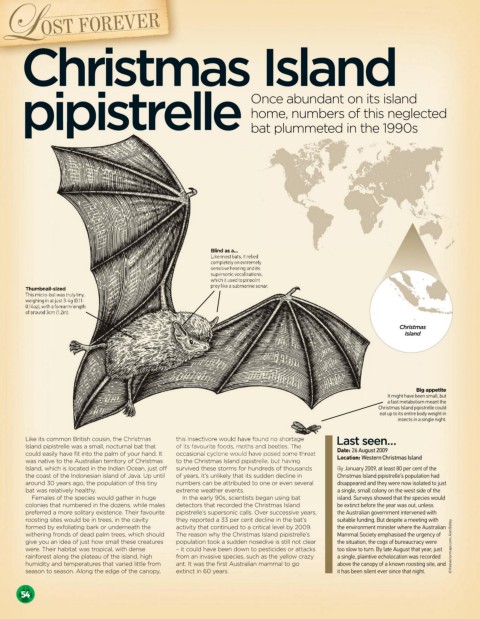
Blind as a...
Blind as a...
Like most bats, it relied
Like most bats, it relied
completely on extremely
completely on extremely
sensitive hearing and its
sensitive hearing and its
supersonic vocalisations,
supersonic vocalisations,
which it used to pinpoint
which it used to pinpoint
prey like a submarine sonar.
Thumbnail-sized
T humbnail-siz ed prey like a submarine sonar.
This micro-bat was truly tiny,
This micro-bat was truly tiny,
weighing in at just 3-4g (0.11-
weighing in at just 3-4g (0.11-
0.14oz), with a forearm length
0.14oz), with a forearm length
of around 3cm (1.2in).
of around 3cm (1.2in).
Christmas
Island
Big appetite
It might have been small, but
a fast metabolism meant the
Christmas Island pipistrelle could
eat up to its entire body weight in
insects in a single night.
as
t
L
…
s
een
u
o
d h
l
r
o
e w
v
o
r
o s
h
g
e
t
a
d n
e f
L
a
v
u
n
Like its common British cousin, the Christmas this insectivore would have found no shortage Last seen…
o
s
i
n
k
h c
o
u
r
i
s
h
, t
h
e C
o
n B
i
m
m
o
s c
t
i
s
i
t
r
e i
i
c
n
t
h
s
e
s i
t
m
i
t
s
a
of its favourite foods, moths and beetles. The
Island pipistrelle was a small, nocturnal bat that
Island pipistrelle was a small, nocturnal bat that of its favourite foods, moths and beetles. The
Date: 26 August 2009
could easily have fit into the palm of your hand. It occasional cyclone would have posed some threat Date: 26 August 2009
occasional cyclone would have posed some threat
Location:
was native to the Australian territory of Christmas to the Christmas Island pipistrelle, but having Location: Western Christmas Island
to the Christmas Island pipistrelle, but having
Island, which is located in the Indian Ocean, just off survived these storms for hundreds of thousands B y J a n u a r y 2 0 0 9 , a t l e a s t 8 0 p e r c e n t o f t h e
survived these storms for hundreds of thousands
By January 2009, at least 80 per cent of the
the coast of the Indonesian island of Java. Up until of years, it’s unlikely that its sudden decline in Christmas Island pipistrelle’s population had
rel
l
at
n
o
s
pi
t
d
i
s
p
o
p
’
l
e
u
ha
m
t
a
s
h
C
r
s
i
d
n
pi
a
Is
l
around 30 years ago, the population of this tiny numbers can be attributed to one or even several disappeared and they were now isolated to just
bat was relatively healthy. extreme weather events. a single, small colony on the west side of the
Females of the species would gather in huge In the early 90s, scientists began using bat island. Surveys showed that the species would
colonies that numbered in the dozens, while males detectors that recorded the Christmas Island be extinct before the year was out, unless
preferred a more solitary existence. Their favourite pipistrelle’s supersonic calls. Over successive years, the Australian government intervened with
roosting sites would be in trees, in the cavity they reported a 33 per cent decline in the bat’s suitable funding. But despite a meeting with
formed by exfoliating bark or underneath the activity that continued to a critical level by 2009. the environment minister where the Australian
withering fronds of dead palm trees, which should The reason why the Christmas Island pipistrelle’s Mammal Society emphasised the urgency of
give you an idea of just how small these creatures population took a sudden nosedive is still not clear the situation, the cogs of bureaucracy were
were. Their habitat was tropical, with dense – it could have been down to pesticides or attacks too slow to turn. By late August that year, just © freevectormaps.com; Alan Batley
rainforest along the plateau of the island, high from an invasive species, such as the yellow crazy a single, plaintive echolocation was recorded
humidity and temperatures that varied little from ant. It was the first Australian mammal to go above the canopy of a known roosting site, and
season to season. Along the edge of the canopy, extinct in 60 years. it has been silent ever since that night.
54

