


Page 59 - World of Animals - Issue #28 Magazine
P. 59
Robins: heroes or villains?
Finding a mate
Robin behaviour The breeding season generally starts
around March, though this can be earlier
if it’s been a mild winter. Both male and
female robins sing to find one another
Family splits and to stake their claim to a territory.
In the winter, the male will oen
drive out the female and offspring
from his territory. Some robins
stay in the UK all year round, but
others migrate for the winter.
Setting up home
The female takes responsibility for
building the nest, typically in nooks
and crannies near the ground, such
as tree roots, hedges and walls.
The nest is mostly comprised of
leaves, moss and hair.
Staking a claim
Both robins will fiercely defend
Raising the kids their territory, which covers around
Aer roughly 13 days of half a hectare (1.2 acres). If singing
incubation by the mother, and bearing their fiery feathers are
the eggs hatch. Now not enough to see off rivals, they
both parents take turns will fly at intruders. Sometimes
to gather food and keep they will even fight to the death!
the chicks warm. They Breadwinner
will fledge aer about While the female is
two weeks, though the homemaking, the male isn’t
parents – particularly being idle; he will provide
dad – will continue to about a third of his mate’s food
care for them for several during this period of courtship.
weeks aer that. The
female, meanwhile,
starts preparing a nest
for a second brood.
Laying eggs
A normal clutch consists of four to six
eggs, one laid each day. They are pale Molt
blue in colour, owing to a pigment called By the end of the summer, both adults and
biliverdin. Studies suggest that the juveniles will be noticeably quieter and less
vibrancy of the blue indicates the health visible. This is because they are undergoing the
of the female, and brighter eggs will be annual molt, an energy-draining event where
cared for more tenderly by males. old feathers are replaced with new ones.
Split personality
When it comes to behaviour, robins really are the Jekyll
and Hyde of British birds. Around humans, they are some
of the most sociable and inquisitive birds to visit our
gardens, often venturing surprisingly close to pick up bugs
from freshly turned earth. They are attentive partners
and hard-working parents, rearing as many as four or five
clutches of chicks over a season.
But when it comes to rival robins, these sweet birds
see red. Throughout the year, what we hear as cheerful
chirping is, in fact, a curt message telling others, in no
uncertain terms, to keep away. If this is ignored, robins will
find a prominent perch, lift their head and present their
bright plumage as a final warning; usually at this point,
one will defer to the other. If singing and posturing doesn’t
scare off the competitor, robins revert to violence. Flying
at their adversary, they will peck and scratch with their
talons until one concedes defeat or, in extreme cases, is
killed – often by the severing of the spinal cord. Indeed, an
estimated 10 per cent of adult robin deaths are committed
by members of their own species.
“The cheerful chirping is in
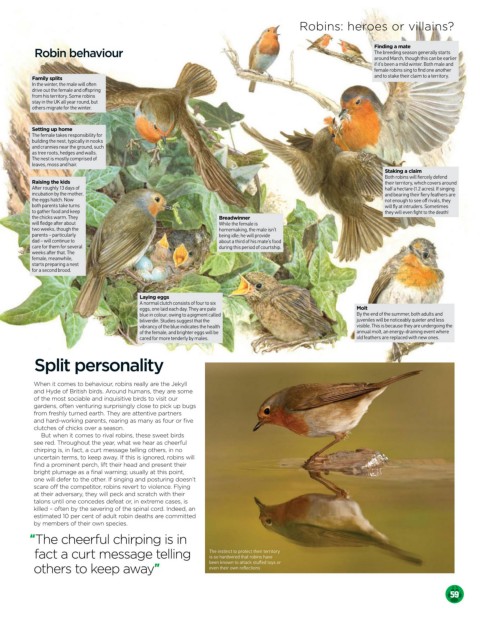
fact a curt message telling The instinct to protect their territory
is so hardwired that robins have
others to keep away” been known to attack stuffed toys or
even their own reflections
59

