


Page 58 - World of Animals - Issue #28 Magazine
P. 58
Robins: heroes or villains?

            The little bird that


            stole our hearts


            On the same day as 2015’s UK general election, more than 224,000 Britons
            took part in a poll to elect the nation’s favourite bird. The shortlist starred
            many of our country’s avian icons, including the barn owl, the mute swan
            and the puffin, but it was an everyday garden visitor, the robin, which flew


            away with the top spot, securing 34 per cent of the votes.
              What is it about robins that so captures our imagination? With a range
            spanning from Siberia, throughout Europe, to as far south as northern
            Africa, it’s not as if they’re exclusively ‘ours’. In fact, virtually every continent
            has its own ‘robin’, though for the most part, these are not related species
            – the one thing they have in common is that distinctive reddish chest.
              To so decisively thrash the other contenders, you can only assume that
            our love affair with this peppy bird goes beyond the colour of its plumage,
            though. The truth is, this little songbird has been earning our affections for
            centuries. As in all politics, it comes down to the best all-round campaign:
            building trust by getting closer than most garden birds; tirelessly broadcasting

            from sunrise to sunset with their bright, confident song; and, of course, scoring
            a huge PR victory by becoming the bird that represents Christmas.
              But there’s another far less wholesome side to this candidate. When it comes
            to defending its turf, the robin will go to any lengths to keep out rivals. It will try
            to out-sing, and then to out-dazzle. But if all else fails, it’s not afraid to resort to
            violence or even murder. Which leads to the question: do we really know our favourite
            bird as well as we thought?

            Our love affair with this peppy bird goes
           “Our love affair with this peppy bird goes
            beyond the colour of its plumage”
            beyond the colour of its plumage”


                                                                                        e
            Adult robinin
                                                                                            o
                                                                                                 n
                                                                                              bi
                                                                                           r
                                                                              J
            A d ult  r o b                                                    Juvenile robin               poll, a campaign is now underway to
                                                                                uv
                                                                                   e
                                                                                       i
                                                                                        l
                                                                                     n
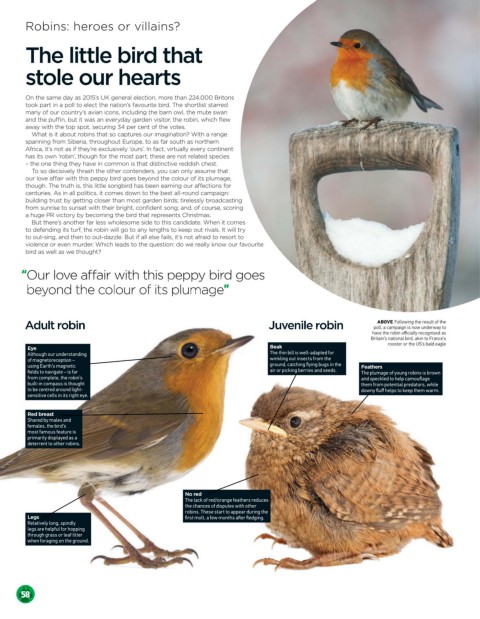
                                                                                                            ABOVE Following the result of the

                                                                                                          have the robin offi cially recognised as
                                                                                                          Britain’s national bird, akin to France’s
             Eye                                                               Beak                            rooster or the US’s bald eagle
             Although our understanding                                        The thin bill is well-adapted for
             of magnetoreception –                                             winkling out insects from the

             using Earth’s magnetic                                            ground, catching flying bugs in the   Feathers

             fields to navigate – is far                                        air or picking berries and seeds.  The plumage of young robins is brown
             from complete, the robin’s                                                                and speckled to help camouflage

             built-in compass is thought                                                               them from potential predators, while
             to be centred around light-                                                               downy fluff helps to keep them warm.


             sensitive cells in its right eye.
             Red breast
             Shared by males and
             females, the bird’s
             most famous feature is
             primarily displayed as a
             deterrent to other robins.
                                                       No red
                                                       The lack of red/orange feathers reduces
                                                       the chances of disputes with other
                                                       robins. These start to appear during the
             Legs                                      first molt, a few months a er fledging.


             Relatively long, spindly
             legs are helpful for hopping
             through grass or leaf litter
             when foraging on the ground.
           58

