


Page 79 - Motor Trend (February 2020)
P. 79
Stunt Drivers  I  FEATURE


                         ‘IF WE WANT A SCENE TO LOOK FAST,

                                  IT’S BETTER IF WE DRIVE FAST’


                                                                        WORDS ALEX LEANSE


            raw. “The biggest difference, and a plus      was one of those drivers. He attributes      lot different than stunt driving expe-
            for us, is that there weren’t any electronic   his ability to drive for the camera to his   rience,” he said. “That, along with real
            safety devices making the cars try to save    motorsports experience. “Ultimately it’s     speed, makes a big difference in doing
            themselves,” Nagle said. “They were pure      the same principles,” he said, but, “What    something practically and not having
            cars; everything that happened with           the limit is on a racetrack and what the     to alter it in post-production—we know
            them was up to the driver. And that’s why     limit is for the camera are very different.”  viewers can see the difference.”
            I recruited the drivers I did: I knew they      Although safety concerns—and the             To that end, Nagle relied on post-pro-
            would be more capable of handling that.”      need for camera cars to keep up—make         duction effects as little as possible.
              Derek Hill, the Daytona 24 Hour and         it rare that stunt drivers go flat-out.       “Your eye knows the difference,” he
            Sebring 12 Hour class winner (and son of      The goal is always to make things look       said. “If there’s something in the deep
            Le Mans and Formula 1 icon Phil Hill),        realistic and exciting. “We’ve got to follow  background or a car in a very precarious
                                                          our cues and hit our marks, but also give    spot, that’s a different story. But for the
                                                          it some action,” Hill said. “We might try    principal action, what you’re focused on,
                                                          and make the car move around more than  I do everything I can to make it real.”
                                                          it would on a racetrack at that speed. You     As such, high speeds were a necessity.
                                                          have to be precise on a racetrack, but it’s   “On the Daytona straightaways, we were
                                                          a different sort of precision on a movie     doing at least 160 mph,” Nagle said. “For
                                                          set—driving within inches of a camera car  the shot at Le Mans’ Mulsanne Straight,
                                                          or keeping in sequence with other stunt      speeds approached 185 mph. That’s the
                                                          drivers to set up a shot.”                   realism I wanted and the realism James
                                                            Rallycross and drift racing champion       Mangold wanted. If we want a scene to
                                                          Tanner Foust also brought his skills to the  look fast, it’s better if we drive fast.”
                                                          production. “Virtually all of the drivers      Although trained stunt drivers bring
                                                          involved had race experience, which is a     awesome skills to a movie set, selecting
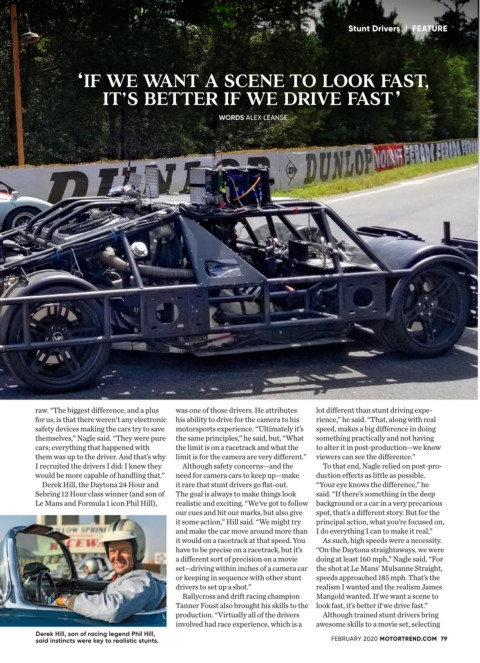
            Derek Hill, son of racing legend Phil Hill,
            said instincts were key to realistic stunts.                                                    FEBRUARY 2020 MOTORTREND.COM  79

