


Page 80 - Motor Trend (February 2020)
P. 80
FEATURE
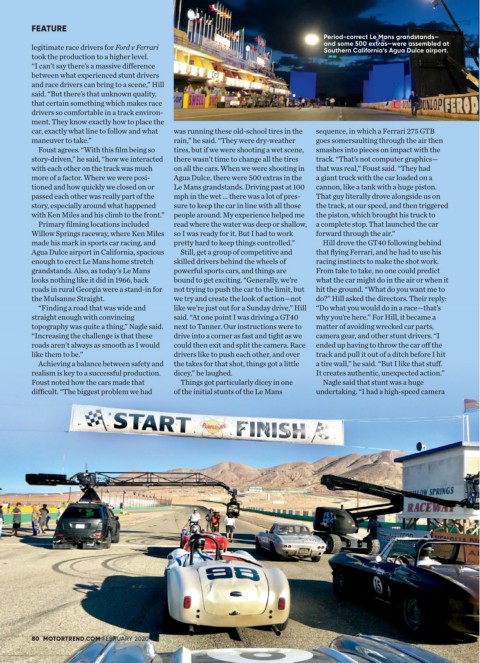
                                                                                                         Period-correct Le Mans grandstands—
                                                                                                         and some 500 extras—were assembled at
           legitimate race drivers for Ford v Ferrari
                                                                                                         Southern California’s Agua Dulce airport.
           took the production to a higher level.
           “I can’t say there’s a massive difference
           between what experienced stunt drivers
           and race drivers can bring to a scene,” Hill
           said. “But there’s that unknown quality,
           that certain something which makes race
           drivers so comfortable in a track environ-
           ment. They know exactly how to place the
           car, exactly what line to follow and what     was running these old-school tires in the     sequence, in which a Ferrari 275 GTB
           maneuver to take.”                            rain,” he said. “They were dry-weather        goes somersaulting through the air then
             Foust agrees. “With this film being so       tires, but if we were shooting a wet scene,   smashes into pieces on impact with the
           story-driven,” he said, “how we interacted    there wasn’t time to change all the tires     track. “That’s not computer graphics—
           with each other on the track was much         on all the cars. When we were shooting in     that was real,” Foust said. “They had
           more of a factor. Where we were posi-         Agua Dulce, there were 500 extras in the      a giant truck with the car loaded on a
           tioned and how quickly we closed on or        Le Mans grandstands. Driving past at 100      cannon, like a tank with a huge piston.
           passed each other was really part of the      mph in the wet … there was a lot of pres-     That guy literally drove alongside us on
           story, especially around what happened        sure to keep the car in line with all those   the track, at our speed, and then triggered
           with Ken Miles and his climb to the front.”   people around. My experience helped me        the piston, which brought his truck to
             Primary filming locations included           read where the water was deep or shallow,     a complete stop. That launched the car
           Willow Springs raceway, where Ken Miles       so I was ready for it. But I had to work      forward through the air.”
           made his mark in sports car racing, and       pretty hard to keep things controlled.”         Hill drove the GT40 following behind
           Agua Dulce airport in California, spacious      Still, get a group of competitive and       that flying Ferrari, and he had to use his
           enough to erect Le Mans home stretch          skilled drivers behind the wheels of          racing instincts to make the shot work.
           grandstands. Also, as today’s Le Mans         powerful sports cars, and things are          From take to take, no one could predict
           looks nothing like it did in 1966, back       bound to get exciting. “Generally, we’re      what the car might do in the air or when it
           roads in rural Georgia were a stand-in for    not trying to push the car to the limit, but   hit the ground. “What do you want me to
           the Mulsanne Straight.                        we try and create the look of action—not      do?” Hill asked the directors. Their reply:
             “Finding a road that was wide and           like we’re just out for a Sunday drive,” Hill   “Do what you would do in a race—that’s
           straight enough with convincing               said. “At one point I was driving a GT40      why you’re here.” For Hill, it became a
           topography was quite a thing,” Nagle said.    next to Tanner. Our instructions were to      matter of avoiding wrecked car parts,
           “Increasing the challenge is that these       drive into a corner as fast and tight as we   camera gear, and other stunt drivers. “I
           roads aren’t always as smooth as I would      could then exit and split the camera. Race    ended up having to throw the car off the
           like them to be.”                             drivers like to push each other, and over     track and pull it out of a ditch before I hit
             Achieving a balance between safety and      the takes for that shot, things got a little   a tire wall,” he said. “But I like that stuff.
           realism is key to a successful production.    dicey,” he laughed.                           It creates authentic, unexpected action.”
           Foust noted how the cars made that              Things got particularly dicey in one          Nagle said that stunt was a huge
           difficult. “The biggest problem we had         of the initial stunts of the Le Mans          undertaking. “I had a high-speed camera


           80  MOTORTREND.COM FEBRUARY 2020

