


Page 146 - World of Animals - Book of Sharks & Ocean Predators
P. 146
Sharks & Ocean Predators
                               WorldMags.net

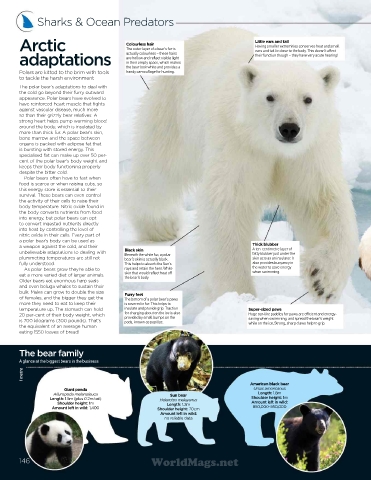
        Arctic                               Colourless hair                               Little ears and tail
                                                                                           Having smaller extremities conserves heat and small
                                             The outer layer of a bear’s fur is
                                                                                           ears and tail lie close to the body. This doesn’t affect
        adaptations                          actually colourless – these hairs             their function though – they have very acute hearing!

                                             are hollow and reflect visible light
                                             in their empty space, which makes
                                             the bear look white and provides a
        Polars are kitted to the brim with tools   handy camouflage for hunting.

        to tackle the harsh environment
        The polar bear’s adaptations to deal with
        the cold go beyond their furry outward
        appearance. Polar bears have evolved to
        have reinforced heart muscle that fi ghts
        against vascular disease, much more
        so than their grizzly bear relatives. A
        strong heart helps pump warming blood
        around the body, which is insulated by
        more than thick fur. A polar bear’s skin,
        bone marrow and the space between
        organs is packed with adipose fat that
        is bursting with stored energy. This
        specialised fat can make up over 50 per-
        cent of the polar bear’s body weight and
        keeps their body functioning properly
        despite the bitter cold.
          Polar bears often have to fast when
        food is scarce or when raising cubs, so
        this energy store is essential to their
        survival. These bears can even control
        the activity of their cells to raise their
        body temperature. Nitric oxide found in
        the body converts nutrients from food
        into energy, but polar bears can opt
        to convert ingested nutrients directly
        into heat by controlling the level of
        nitric oxide in their cells. Every part of
        a polar bear’s body can be used as
                                                                                          Thick blubber
        a weapon against the cold, and their
                                             Black skin                                   A ten-centimetre layer of
        unbelievable adaptations to dealing with                                          fatty blubber just under the
                                             Beneath the white fur, a polar
        plummeting temperatures are still not   bear’s skin is actually black.            skin acts as an insulator. It
        fully understood.                    This helps to absorb the Sun’s               also provides buoyancy in
          As polar bears grow they’re able to   rays and retain the heat. White           the water to save energy

                                             skin that would reflect heat off               when swimming.
        eat a more varied diet of larger animals.
                                             the bear’s body.
        Older bears eat enormous harp seals
        and even beluga whales to sustain their
        bulk. Males can grow to double the size
                                             Furry feet
        of females, and the bigger they get the   The bottom of a polar bear’s paws
        more they need to eat to keep their   is covered in fur. This helps to
        temperature up. The stomach can hold   insulate and provide grip. Traction      Super-sized paws
                                             for charging about on the ice is also


        20 per-cent of their body weight, which                                         Huge oar-like paddles for paws are efficient and energy-
                                             provided by small bumps on the             saving when swimming, and spread the bear’s weight
        is 700 kilograms (300 pounds). That’s   pads, known as papillae.                while on the ice. Strong, sharp claws help to grip.
        the equivalent of an average human
        eating 1550 loaves of bread!
        The bear family
        A glance at the biggest bears in the business
         1 metre
                                                                                         American black bear
                        Giant panda                                                       Ursus americanus
                    Ailuropoda melanoleuca                   Sun bear                       Length: 1.8m
                   Length: 1.5m (plus 0.2m tail)         Helarctos malayanus             Shoulder height: 1m
                     Shoulder height: 1m                    Length: 1.2m                 Amount left in wild:
                   Amount left in wild: 1,400           Shoulder height: 70cm             850,000-950,000
                                                         Amount left in wild:
                                                           no reliable data


        146
                                                      WorldMags.net
                                                      WorldMags.net

